By Ademola Adeyoju
The English language is fluid, dynamic, and highly subjective.
If you read that statement carefully, you would realise that I inserted a comma after “dynamic”. Now, most writers would simply write, “The English Language is fluid, dynamic and highly subjective.” But which really is the right way to write?
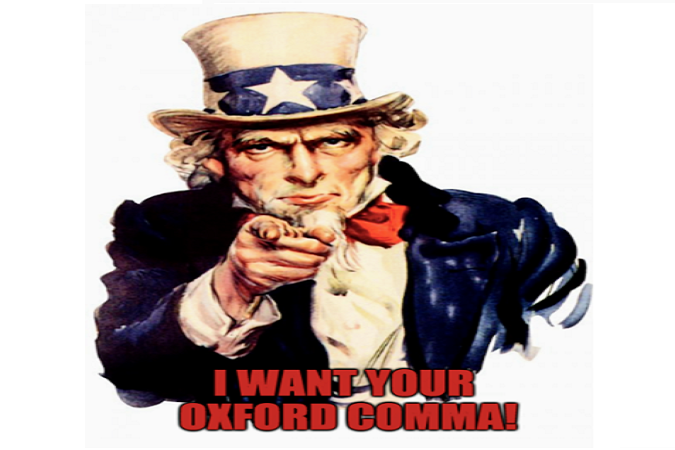
There have been arguments on whether or not a serial comma[1] should be inserted after the penultimate item in a list of three or more things. Some styles — the APA style, the Chicago Manual of Style, the US Government Printing Office Style Manual, and the Oxford University Press — mandate the use of the Oxford comma, while some others — The Los Angeles Times, The Times, Associated Press Stylebook, and The Canadian Press—recommend against its use. Some other styles preach economy — For instance, The New York Times Style Guide recommends the use of the Oxford comma[2] only when it is necessary: otherwise, the Guide supposes that the use of the Oxford comma is just a clutter that would slow writers — and readers — down.
So, should it be “A, B, and C” or “A, B and C”?
Ordinarily, both are correct. But it is desirable that the Oxford comma be used to eliminate ambiguity. The famous editor of the Black’s Law Dictionary, Bryan Garner, thinks so too. In any case, there are no advantages to omitting the Oxford comma. So why not use it?
The Times once published a humorous description of a Peter Ustinov documentary, which retraces a journey made by Mark Twain a century ago. The Times noted that “the highlights of his global tour include encounters with Nelson Mandela, an 800-year-old demigod and a dildo collector.” Surely, a serial comma inserted after ‘an 800-year-old demigod’ would have infused some clarity into the expression, and make it sound a lot less like Nelson Mandela is an 800-year-old demigod and a dildo collector.
The above incidence affords a classic instance of the importance of the Oxford comma.
Both pro- and anti-Oxford comma factions can be found in all media — book writers and publishers tend to fall in the former group and newspapers in the latter group. But as Warren Clement counsels, do not mind the newspaper writers — they “throw caution to the wind, laugh in the face of doom, and deny employment to the Oxford comma. [They] shall pay one day for [their] recklessness. It will be comma karma”.[3]
Even if journalists and newspapers do not care about the Oxford comma, it should be a compulsory requirement in law and in all writings upon which clarity and interpretation human lives or millions of dollars may hinge. This goes without saying then, that every lawyer, legislator, and draftsman should pay special attention to the Oxford comma when drafting any documents, particularly those that are sensitive.
Emperical evidence shows that most lawyers and draftsmen have absolutely no understanding of the essence and importance of the Oxford comma. Most, if not all, our Statutes suffer from defects, among which the Oxford comma is chief. Yet history has demonstrated that grave consequences may be suffered when the serial comma is ignored.
O’Connor v Oakhurst Dairy
In 2014, a multimillion-dollar case was instituted for lack of a comma. Kevin O’Connor, along with about 75 other drivers filed a class-action lawsuit against Oakhurst Dairy for four years of unpaid overtime wages.[4] According to the Maine state law, workers are not entitled to overtime pay for: “[t]he canning, processing, preserving, freezing, drying, marketing, storing, packing for shipment or distribution of: (1) Agricultural produce; (2) Meat and fish products; and (3) Perishable foods.”
Without a comma after “shipment,” the “packing for shipment or distribution” looks like a single activity. The drivers argued that if a comma had been there, it would have been clear that those who simply distribute goods (as against, say, factory workers who pack for shipment) were also exempted. And since truck drivers do not pack food — either for shipment or distribution (they simply deliver it) — the exemption from overtime pay do not apply to them. They claimed that they were, therefore, entitled to overtime pay.[5]
The dairy company won at the District Court, but on appeal, the United States Court of Appeals For the First Circuit reversed the decision, holding that the Maine law — ambiguous as it is — must be construed narrowly in favour of the truck drivers. “[F]or want of a comma, we have this case,” says Judge David J Barron, who delivered the lead opinion. Eventually, the case was settled out of court for $5 million in 2017: but the lesson was learnt, in a very costly way.
If it has happened before, it may happen again. The Holy Bible says this too in the book of Ecclesiastes.[6]
Less-than-flawless writing is unacceptable in the legal profession, and while it is not true that the Oxford comma is always necessary, it does no harm to take precautions. As Loraine puts it: “The idea that a simple comma could make or break a case should be a wake-up call for everyone. Leave the careless writing and punctuation to the social bloggers. Our clients pay us to be consummate professionals, and we should work every day to earn their trust — Oxford comma included.”[7]
Onwuzulike v State
Addressing the issue of punctuations generally, Honourable Justice Tur of the Court of Appeal of Nigeria held recently in Onwuzulike v State[8] that, “since punctuations are inserted by the draftsman in modern statutes, I do not see any rational reason why the Courts should disregard them in the interpretation of any section, subsection or paragraphs and sub-paragraphs in a statute or rule of Court. “[9] So, as far as everything legal is concerned, “the slightest misstep in punctuating a clause can have massive unintended consequences.”[10] (In 1872, one misplaced comma in a Tariff Act cost the American government and taxpayers more than $2 million — the equivalent of over $40,000,000 in today’s dollars. Again, in 1999, Lockheed Martin, a multi-billion dollar corporation also lost $70 million after one comma typo in an international contract.)
Conclusion
There are two types of people: those who use the Oxford comma and those who want to see the world burn. Join the former’s camp. You should write: “I have read Hamlet, the Holy Bible, and Kama Sutra” unless you intend to create an incestuous relationship between the Holy Bible and the ancient Indian Sanskrit book on sexuality. Even when you use a disjunctive mark (that is, ‘or’), always use the Oxford comma. Better safe than sorry!
[1] A serial comma and the Oxford comma basically describe the same thing, and can be used interchangeably.
[2] The Oxford comma is so-called because the controller of the University Press, Horace Hart, had recommended it in 1893 in a set of rules for use by press employees.
[3] Warren Clements, ‘The case for and against the Oxford comma’ (2011) Available at: https://www.theglobeandmail.com/amp/arts/the-case-for-and-against-the-oxford-comma/article625889 Accessed on 9 March 2019
[4] O’Connor v Oakhurst Dairy, No. 16-1901 (1st Cir. 2017)
[5] For a more elaborate discourse on the issues involved in this case, see Mary Norris, ‘A Few Words About That Ten-Million-Dollar Serial Comma’, (2017) Available at: https://www.newyorker.com/culture/culture-desk/a-few-words-about-that-ten-million-dollar-serial-comma Accessed on 9 March 2019
[6] Ecclesiastes Chapter 1, verse 9, Good News Translation.
[7] Loraine M. DiSalvo, ‘When Punctuation Sets Precedent: A Lesson for Companies, Everywhere. Available from: https://morgandisalvo.com/wp-content/uploads/2017/03/When-Punctuation-Sets-Precedent-v2.pdf Accessed on 15 March 2018
[8] Onwuzulike V. State (2017) LPELR-41889(CA)
[9] Ibid. (Pp. 129-138, Paras. D-B)
[10] Chris Stokel-Walker, ‘The commas that cost companies millions’, (2018) Available at: http://www.bbc.com/capital/story/20180723-the-commas-that-cost-companies-millions Accessed on 9 March 2019