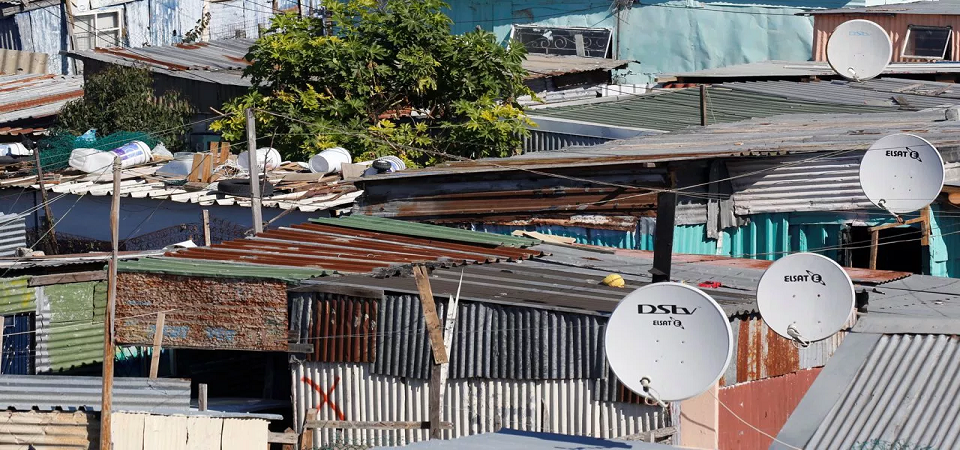
Nigerian Government launches a satellite TV initiative supported by the Government of China. Our government has selected 1,000 villages to test-run the service which will carry 30 digital channels. If these channels have European football via Chinese licensing rights, through satellite, MultiChoice’s DStv Nigeria has a headache.
The Minister of Information and Culture, Lai Mohammed, has launched a project to provide free satellite television to 1000 villages across Nigeria.
The project is being funded by the government of China.
Mr Mohammed flagged off the project Monday in Kpaduma 3, a village in the Federal Capital Territory, (FCT).
The minister said the 1000 Villages Satellite TV Project was announced by Chinese President Xi Jinping at the 2015 Forum on China-Africa Cooperation (FOCAC) in Johannesburg, South Africa.
He said the project is under the ”Ten Major China-Africa Cooperation Plans” that were announced at the event.
[…]
”With access to more than 30 digital channels, with crystal clear pictures and Hi-Fidelity audio, the DSO roll-out brings the benefits of digital television to all households.
”We call this the democratisation of information and entertainment, ” he said.
Mr Mohammed said the 1,000 villages project could not have come at a better time.
In my previous piece on 5G, I mentioned the use of Network Slicing, Network Function Virtualisation (NFV) and Software Defined Networking (SDN) as possible technologies to achieve virtualization and softwarisation within the core of the 5G network. The softwarisation of the 5G network has in essence triggered the development of new business models for 5G which were not possible using the architecture of previous cellular generation. For example, Network as a service, Radio as a Service etc. are services that can be offered due to the virtualized environment. Here, I delve a bit about the use of Network Slice as a tool to aid the development of new business models for 5G.
A network slice is simply an end to end logical network running on a shared physical infrastructure. It offers a way to deliver services with different requirements within the same physical infrastructure in a 5G network.
5G is typically classified in terms of ultra-high bandwidth, ultra-reliable and low latency and Internet of Things (IoT) applications. For example, a remote surgeon may require low latency to aid his surgical procedure whereas a customer with AR/VR technology may require ultra-high bandwidth to download a TV broadcast. These service requirements are different and can be uniquely delivered on network slices tailored to the needs of the consumers.
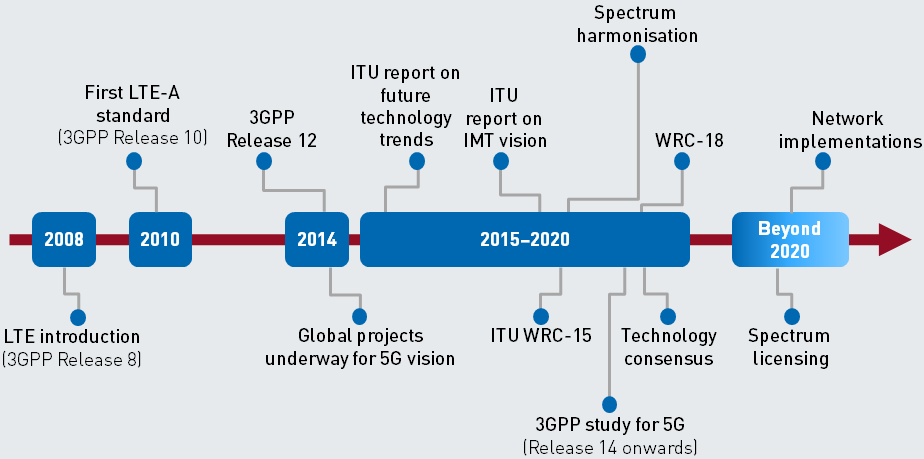
Timeline towards 5G [Source: Analysys Mason, 2014]It is also possible that a client (or vertical) require two or more of these services simultaneously, for instance, an automated car may require high bandwidth for its entertainment as well as low latency for assisted driving; these services could be delivered on different slices packaged together as a business bundle for the client. The client can also decide to have multiple slices from different operators to serve its needs. Furthermore, a client requiring two or more services may have a unique hierarchy for these services. Thus, network slicing offers the opportunity to tailor the application to meet the need of the client.
Network Slicing has also given mobile operators the opportunity to differentiate their offerings into Network connectivity, where connectivity services such as bandwidth, latency, coverage, mobility etc. are offered to the client and Network resource services, where other resource are offered to the client as services in the form of Big Data analytics, Edge Computing, Cloud Computing, Localisation, Security etc., as highlighted by GSMA.
Slicing can either be vertical or horizontal. Vertical slicing refers to the development of slices to serve the different requirements of the industries (often referred to as verticals). For example, using the example of the automated car above, vertical slicing implies that a slice would be created to meet the entertainment needs within the car and another slice for assisted driving. Horizontal slicing, on the other hand, implies developing slices to meet the needs of individual machines or users. For example, a horizontal slice could serve the need of a consumer in a smart home as well as sensors within a smart industry. For a horizontal slice, the service requirements are the same but requested by different clients.
The use of Network Slicing also presents a challenge when the client roams from its home network to an international network. How do you guarantee that the client enjoys the same quality of experience whilst having access to the tailored slice for his/her application? In order to overcome this challenge, three options have been recommended by GSMA below:
The International network issues a globally agreed slice to the customer.
The International network issues a slice similar to the slice used in the home network.
The Home network request for permission of control of the resources of the international network to provide a slice with the same functionality as previously offered within the home network.
5G is expected to act as the backbone for a variety of verticals ranging from healthcare, manufacturing, consumer applications, transportation, logistics, energy, environment, construction etc. These verticals have a myriad of requirements; hence a one size fits all network architecture would not work. Network Slicing thus offers the opportunity to develop a flexible, agile and elastic network which is able to meet the demands of the verticals on the fly; thus encouraging the development of new business models which help justify the investment in 5G networks.
I just spoke with BuzzFeed on ecommerce in Africa. My thesis remains that we are not close to the inflection point where ecommerce becomes a profitable venture. Unless you can sustain losses as Amazon did for a decade, do not venture yet. Wait for some anchors and enablers to strengthen first.
The easiest way to waste money and destroy value in Nigeria is to start an ecommerce business. As I have noted many years ago in a seminal piece in Harvard Business Review, making money on ecommerce in Africa would happen but would take a really long time. I do not expect any to work till after 2023 (2022). But before then, it is putting good money in a value-destroying venture that would bleed cash until the owners give up. Ecommerce today in Africa is simply a loss-making online endeavor only people with deep pockets can do. You can be in it if you do not care for profitability.
Also, you must have a double play to reduce the exposure emanating from losses from ecommerce operations [the marginal cost paralysis of ecommerce operation makes it largely loss-making). Amazon does that cleverly: as it dismantles many brick-and-mortar stores via its ecommerce operations, many run to the web for new opportunities. You know what happens? Amazon sells them cloud services through AWS.
I explained in the duality element that digital products which thrive are typically both products and platforms. It would be hopeless to build modern digital products without having a moat through platforms. Interestingly, the greatest digital ICT utilities have double plays in their business models: if Amazon decimates many brick-and-mortar stores, it would welcome many online to sell them cloud services. Alibaba welcomes you to its marketplace platforms, and you certainly have signed up for its (partly affiliated) payment processing solutions (Alipay) which command commissions.
So, provided Amazon can keep many flipping from physical stores to digital stores, it would make up any ecommerce loses via the cloud service business. Alibaba does the same: have a free account in my marketplace but you must use my Alipay which attracts commission for processing all transactions.
Unless you have a double play in Africa, think again, as you venture right now in ecommerce. Companies like old Konga, DealDey, OLX, etc never had double play. When that happens, the gestation period to profitability via pure ecommerce operations becomes longer, triggering cashflow challenges which lead to failures. Those challenges emanate because we have severe logistics problems which must be fixed to unlock opportunities in the sector.
Gloo founder (source: Twitter)
Sure – if you have investors who do not care for losses, you can go ahead.
This is an update to an earlier post on startup funding in Africa. This particular note puts the numbers in context across years. Ecommerce is fading while fintech is the bull.
According to numbers compiled in WeeTracker’s Venture Investments Report 2018, US$726 million was invested across 458 deals in African startups. That is a 300% gigantic leap in the total funding amount and over 127% increase in the number of deals as compared to 2017.
Interesting insights, but it would be great to have more investment in healthtech, agritech, edtech and cleantech; the problems of ecommerce are well known, more about physical infrastructures than technology.
It is when other sectors grow that fintech would offer greater value and relevance; you cannot be building banks if you haven’t figured out where the money to put there could come from. Fintech has high growth rate, no doubt, and less capital intensive, but we need to build others for fintechs to truly shine.
Do not underestimate your capacity to effect change in people’s lives and companies. As you plot to build connections especially with those “way higher up” in the business/economic ladder, focus your strategy on how you can help them expand their missions. Yes, it is likely that the richest man in your city will reply to a document where you have articulated how one of his businesses will thrive than one where you are seeking help.
There is a reason for that: the “seeking help” communications rarely reach him; the aides purge them. But the bold vision document typically reaches the big man because even the aides are there to see the company grow.
Find your own mentor – he does not need to be your university professor unless the professor knows and understands business. It is always good to use active practicing professionals who are facing the challenges you are encountering at higher levels.
If you run a business, it does not make sense to pick a big corporation uncle (unless he founded a firm) as a mentor – he is guaranteed income at month end and may have never felt the stress of paying workers, and growing margins. There is urgency that comes when you meet people running their shops, a civil servant would not give you that.
2019 is still very young, and most times, your visions will be executed through networks and people you partner or work with. Take time to think five key people you want to connect in a meaningful way to help in your mission. And then find at least one major way you can help those people in whatever they are doing. Look for the opening to present to them, focusing on the strategic/intellectual part of you.
Do not speak as someone looking for help: make the people to understand you as someone with intellectual and business sagacity that can improve whatever sub-frictions you are focusing on. If you do well, you would be offered the opportunities to do as you said. Interestingly, that is how you would help yourself.
Just like what is obtainable in business model innovation: value creation, value delivery and value capturing. Same is applicable in human relationships, if you really want to be taken seriously.
You must be able to create value (for the rich guy), deliver the same value to him/her, and then capture value, the latter now becomes the help you are looking for or even getting the deserved attention. Seeking to get it any other way may be fraudulent, the rich guy is not your father or mother.
Again, most serious people are not moved when you display that pitiable disposition, playing the victim, as if anyone owes you anything, getting help is never an entitlement. You do not need to make people feel guilty for not helping you, when you haven’t really done anything to deserve help anyway.
Always think of what you can give, and in return you are likely to get what you want.