DD
MM
YYYY

PAGES

DD
MM
YYYY

spot_img

PAGES

Home Blog Page 7011

[Apply] Skoll 100% Scholarship for Oxford MBA, Due Jan 11

0

We received this for Zenvus, our agtech business. If you have interest, it is a good one. Skoll Foundation has been funding changemakers for years with 100% paid Oxford MBA. Yes, the Skoll Centre for Social Entrepreneurship is searching for its next cohort of Skoll Scholars to study on the Oxford MBA in 2019-20.

If you’re doing exceptional work with positive outcomes and want to accelerate your impact, then check out the Skoll Scholarship for the Oxford MBA!

The Skoll Scholarship is a fully-funded scholarship for incoming Oxford MBA students at the University of Oxford’s Saïd Business School. It gives social entrepreneurs exclusive opportunities to meet with world-renowned experts and thought-leaders, as well as the chance to learn valuable business skills with a social entrepreneurship focus.

The Skoll Centre for Social Entrepreneurship is searching for its next cohort of Skoll Scholars to study on the Oxford MBA in 2019-20. But the application deadline is fast approaching!

If you would like to be eligible for the Skoll Scholarship and to start your MBA degree in September 2019 – then you must apply by the stage three deadline on Friday, 11 January 2019.

For more information on the application process for the Skoll Scholarship, check out how to apply.

Campaign of Stomach Infrastructure [Video]

0

We still have an election campaign where spreading money is the message to the citizens. I continue to read this comment put by a LinkedIn user and cannot figure out how the breed of politicians spreading that money will fix the paralysis.

…However, a grave situation indeed entering in 2019 election year. Optimism about alternative revenue source like Taxes and import duties will soon fizzle out once recession ignites, shrinking business expectation sentiments, depleting effective demand and leaving the CBN to curb the ensuing exchange rate and inflation complexities by reducing access to foreign exchange and expanding the list of items banned from import.

The Corporate Longevity of Nations

4

In 1776, Scottish economist and philosopher, Adam Smith wrote his classic – ‘The Wealth of Nations’. That book became one of the most important works in understanding the nature and causes of the wealth of nations. From Milton Friedman to Maynard Keynes and my favorite, Joseph Schumpeter, scholars have pursued the noble course to understand the economic mechanics of nations.

Clayton M. Christensen’s upcoming book, The Prosperity Paradox, has posited that strong corporations build better public institutions because for all government policies, companies have to fund them, through taxes and fees. So, Nigeria’s inability to build enduring corporations would continuously hurt Nigeria’s capacity to improve our public institutions. Yes, if MTN, Glo, Airtel and 9Mobile do not make money, NITDA (National Information Technology Development Agency) will not have money to fund its mandate. And if Nigerian corporations are not profitable, the education tax (TETFUND) would struggle. And interestingly, you do not need governments to be perfect before great companies can be created. Before Central Bank of Nigeria Owerri office, First Bank of Nigeria was partly acting like the bank of last resort in eastern Nigeria, clearing cheques for other banks!

Applying the rigorous and theory-driven analysis he is known for, Christensen suggests a better way. The right kind of innovation not only builds companies—but also builds countries. The Prosperity Paradox identifies the limits of common economic development models, which tend to be top-down efforts, and offers a new framework for economic growth based on entrepreneurship and market-creating innovation. Christensen, Ojomo, and Dillon use successful examples from America’s own economic development, including Ford, Eastman Kodak, and Singer Sewing Machines, and shows how similar models have worked in other regions such as Japan, South Korea, Nigeria, Rwanda, India, Argentina, and Mexico.

Good People, we need to have new operational manifestos in Nigeria. Can we have a Center for Corporate Longevity in each region, hosted by regional leading universities? These centers would focus on understanding the root causes of our industrial paralyses (like the fading of Diamond Bank) which continue to undermine a once virtuoso pragmatic economy.

Nigeria’s Access Bank Plc agreed to take over struggling local rival Diamond Bank Plc in a deal worth about $200 million that would create the nation’s biggest lender by assets. Both companies’ shares rose.

Access will buy Diamond for 3.13 naira a share, with almost a third of that, or about $64 million, being paid for in cash and the rest in shares, the Lagos-based lenders said in statements to the Nigerian stock exchange on Monday. That’s more than triple Diamond’s previous closing price.

Our regulators have not fixed these issues and it seems our companies do not have the capacities to save themselves. As I have noted before, finding enduring companies in Nigeria is hard:” In short, if you sort companies by “40th birthday” in the Nigerian Stock Exchange, and carefully remove entities with international origins, you may struggle for two dozen.”

I was shocked that after 260% premium, Diamond Bank went for $200 million. Think about it – that is one of the nation’s leading companies. In South Africa, one company, Naspers can buy all the companies in Nigerian Stock Exchange with less than 50% of its market value: the Nigerian Stock Exchange total market cap is about $34 billion while one South Africa firm commands $89 billion.
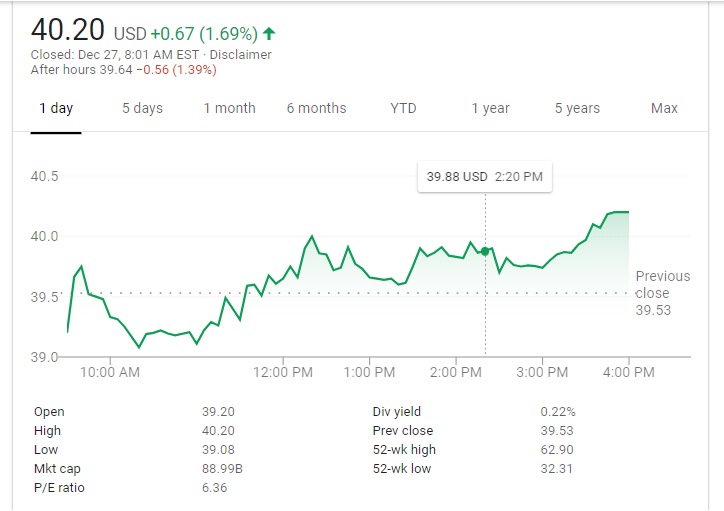
Naspers cap today is about $89 billion while the whole of Nigerian Stock Exchange is about $34 billionThere is a reason why our equities are priced the ways they are: investors do not have the long-game plan in Nigeria. And only Nigeria can change that perception. We need to deepen capabilities to make sure we have long-view corporate institutions.

To our emerging technology hubs, incubators and accelerators, we need to add components that deal with corporate longevity and succession. And it is very important for our universities to spend efforts to have centers that can help our corporations understand these issues. This is no more a regulatory challenge – it is a national problem which must be fixed. Because our firms are not dying because of creative destruction, we need to investigate and discover new roadmaps on the corporate longevity in Nigeria.

All The Major Digital Banks, Payment And Fintech Startups in Nigeria

0

Segun Adeyemi, CEO of Amplified Payment Systems, has written a short ebook, A Guide To The Payments and Fintech Landscape in Nigeria, for lovers of payment, digital banking and fintech with focus on Nigeria. It is a good one. You can read and download it here.

Across the continent, over $560million was invested in tech companies in 2017. Of the $114million reportedly raised by tech companies in Nigeria, 75% of it went to FinTechs. So far in 2018, Nigeria FinTechs have raised over $95million according to publicly available data. If you have been following the startup ecosystem in Nigeria, you are probably inundated with news about FinTechs and their activities on a daily basis. This media attention can be largely attributed to these major investments.

[…]

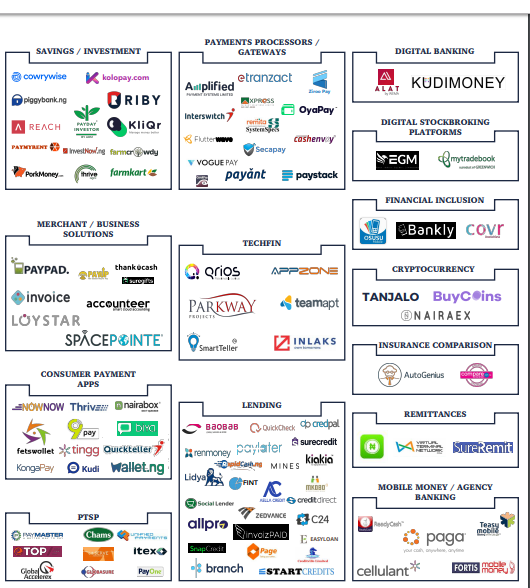
The payment space is the most vibrant and active of the fintech areas in Nigeria. This is as expected because Nigeria is a largely cash based society and there’s a huge opportunity in the digitization of cash transactions. However, beyond the payment space, there are other very active FinTech categories and companies in Nigeria that are tackling big opportunities and using technology to solve real problems in the financial services space

Source: S. Adeyemi, herokuapp

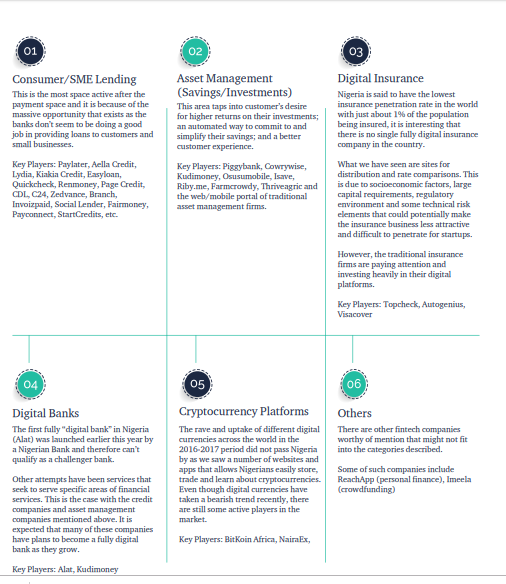
Here are some of the leading payment and broad fintech companies in Nigeria

Source: S. Adeyemi, herokuapp

The Most Important Cost To Understand As A Web Entrepreneur

0

If markets are perfect, the marginal cost of a digital product would be zero. Marginal cost is the cost added by producing one additional unit of a product or service. The implication is thus: if marginal cost is zero, users can pay zero or near-zero. Unfortunately, markets are not perfect, and that means marginal cost is not zero.

In a perfect market, the marginal cost of a digital product is zero. This means that the price of a digital product tends to zero: welcome freemium and ad-supported business. However, only firms with network effects dominate and benefit. The core reason is that if in a perfect market, and the marginal cost of producing digital product is zero, the price will inevitably go to zero.

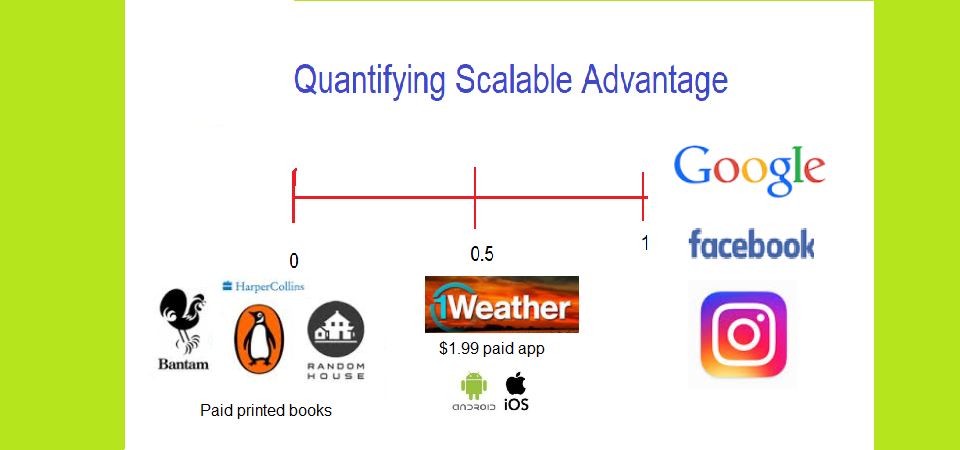
This is the heart of the freemium model where you get many things free, which is possible because of the aggregation construct, where companies provide those digital products and then create an ecosystem to sell adverts. The firms benefit more than the suppliers by providing the platforms [Facebook makes money for photos supplied by families. Sure you like the Likes]. As shown in the Figure, great companies deliver the near-zero marginal price for high quality product, making it challenging for anyone that carries a non-zero marginal price to compete, exacerbated if the product is even not top-grade. This is one of the biggest challenges digital entrepreneurs face.

Nonetheless, as a web entrepreneur, your job is to make that marginal cost near-zero. It is only when you make that possible that you can improve your scalable advantage.

Hacking Growth, Quantifying Scalable Advantage

Digital marginal cost comprises mainly transaction cost and distribution cost. The transaction cost includes processing fees like the ones Paypal and Interswitch charge you. Largely, that cost is agnostic of domain: it is paid whether online or offline.

But distribution cost is the real deal. That is the cost associated with distributing the goods. For a digital product like subscription to my blog, the distribution cost is zero. But if you run an ecommerce company, you have a huge cost to ship the items after the customer has paid. If that distribution cost is not near-zero, you have a problem as a web entrepreneur.

By that I mean: if your distribution cost is huge like an ecommerce company, even though you think you are a web entrepreneur, you are actually NOT running a web business since your cost is now dominated by the offline component. That is the reason why I maintain that an ecommerce company in Nigeria is not a web business but a physical business with a web channel.

Yes, the largest component of the marginal cost is offline and that makes ecommerce an offline business. You know what? Ecommerce entrepreneurs fix that problem by mapping geographical locations within a nation where they can serve customers, making a case why they are not a web business since web businesses are neither constrained nor bounded.

In summary, understand your marginal cost by watching this video below.