DD
MM
YYYY

PAGES

DD
MM
YYYY

spot_img

PAGES

Home Blog Page 7042

The Empires of the Future Will Be Built This Way

2

Many in our community have asked for more insights and perspectives on Platforms after I ran the piece where Uber commanded more market cap than GM, Ford and Fiat Chrysler combined. I had noted a new business model that would rule the 21st century, anchored on the unbounded and unconstrained distribution channel of the internet, delivering near-zero marginal costs with territorial conquering scalable advantages.

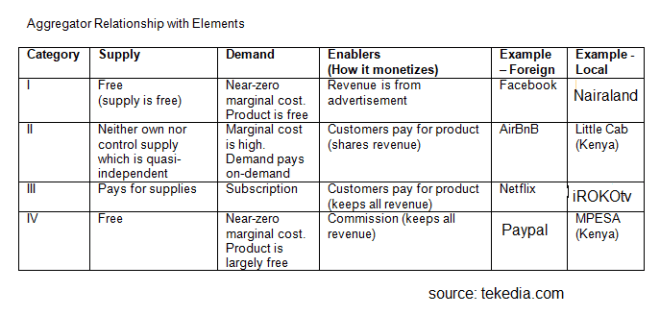
In this piece, I present the elemental relationship with a video, on Aggregation-Integration Construct, explaining at a deeper level what is going on. The empires of the future will be anchored on this Construct.


Nigerian Government Proposes a $29 Billion Budget for 2019

0
2018 Nigeria Budget

Nigerian government proposes a national budget of N8.7 trillion for 2019 fiscal year. That is $28.6 billion or $24.25 billion depending on the exchange rate you prefer (bank rate or black market rate). On absolute naira, it is lower by N400 billion when compared to 2018 budget.

The Federal Government of Nigeria has proposed N8.73trillion for next year’s budget.

The sum is N400bn lower than that of this year.

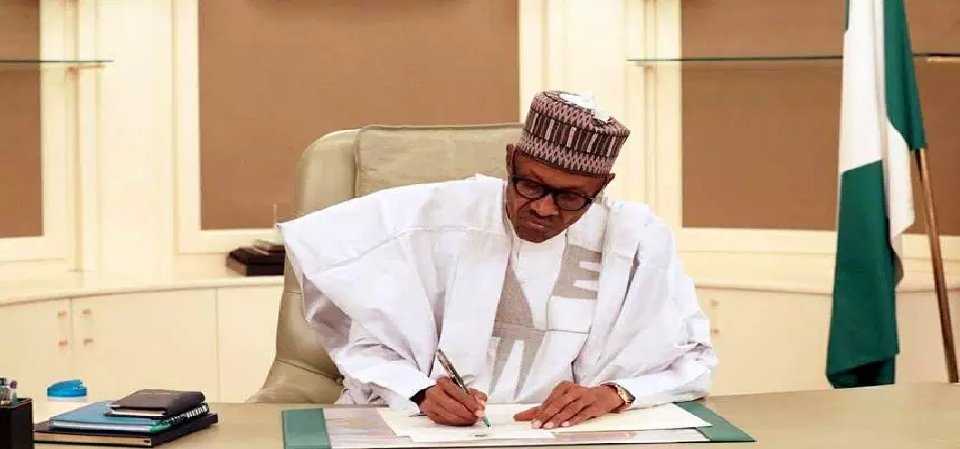
The Minister of Budget and National Planning, Udoma Udoma, stated this Wednesday at the end of the Federal Executive Council (FEC) meeting presided over by President Muhammadu Buhari at the State House, Abuja.

Mr Udoma said the council has pegged the price of crude oil per barrel at $60, as well as exchange rate at $305, while daily crude oil production is put at 2.3m barrels per day.

He said Medium Term Expenditure Framework (MTEF) for 2019 to 2021 has been approved by the council and that it would soon be submitted to National Assembly for further consideration.

The World’s Reigning Business Model – UBER $120 Billion

2

One thing unites all leading modern technology companies: they are platforms. From Google to Facebook, platforms drive competitiveness through near-zero marginal cost which practically triggers the winner-takes-all outcome, as I noted recently in Harvard Business Review. Platforms create moats which ensure these ICT utilities are not easily disrupted because once a platform takes off, its inherent mutability makes it better, through a positive continuum in an amazing digital virtuoso circle. Yes, once that platform gets a separation, it attracts more users, and more people join, and that process makes it even better that after many circles, it conquers its territory as the undisputed category-king.

Uber’s $120 billion

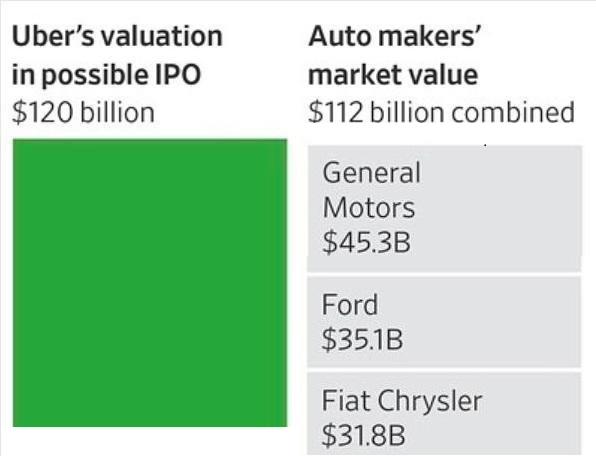
Uber is projected to hit the market at $120 billion valuation, WSJ reports. That is more than the total market values of Ford, GM and Fiat Chrysler.

Uber Technologies Inc. recently received proposals from Wall Street banks valuing the ride-hailing company at as much as $120 billion in an initial public offering that could take place early next year, according to people familiar with the matter.

That eye-popping figure is nearly double Uber’s valuation in a fundraising round two months ago and more than General Motors Co. , Ford Motor Co. and Fiat Chrysler Automobiles NV are worth combined.

Uber’s plans now set up a race with rival Lyft Inc., which is also eyeing a debut in the first half of the year, The Wall Street Journal separately reported Tuesday. Lyft’s valuation is expected to top the $15.1 billion it sold shares at privately this year.

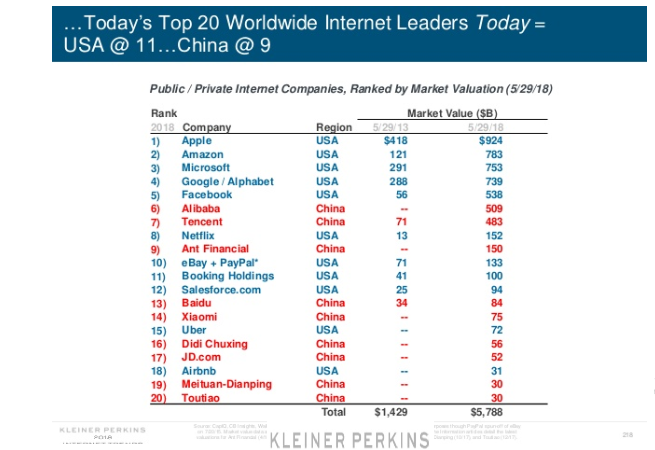
The business model which Uber has deployed in the logistics sector is called Aggregation – a key component of that platform business system. It is the winning business model of the 21st century in the technology space where Internet has enabled the scaling of many things through an unconstrained distribution, enabling near-zero marginal cost. Nearly all companies in the top 20 digital technology companies have some elements of this business model. If your business model cannot incorporate this, it is possible you are missing something strategically, as a technology company.

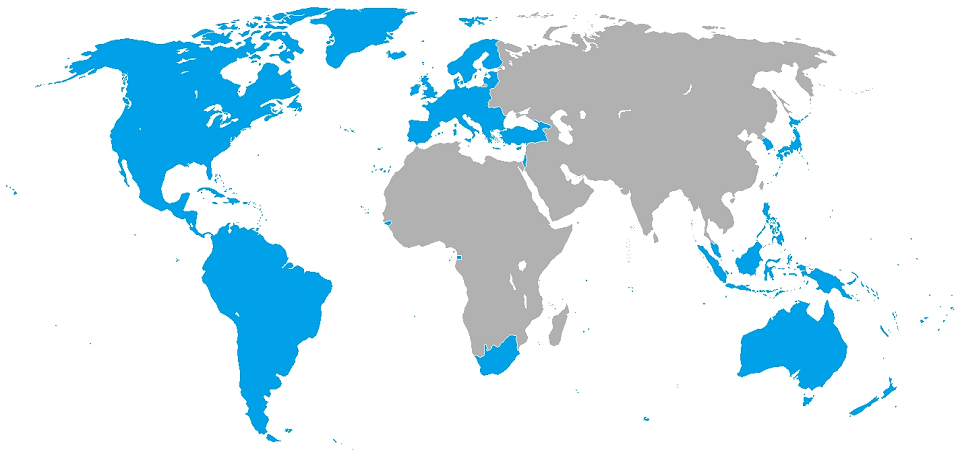
2018 Internet Trends â?? Top 20 Global Internet Firms; US 11, China 9

World Bank’s IFC Plans to Invest $3 Million in Nigeria’s Kobo360 Logistics, IFC Filing Shows

0

World Bank’s IFC Plans to Invest $3 Million in Nigeria’s Kobo360 Logistics, IFC Filing Shows.

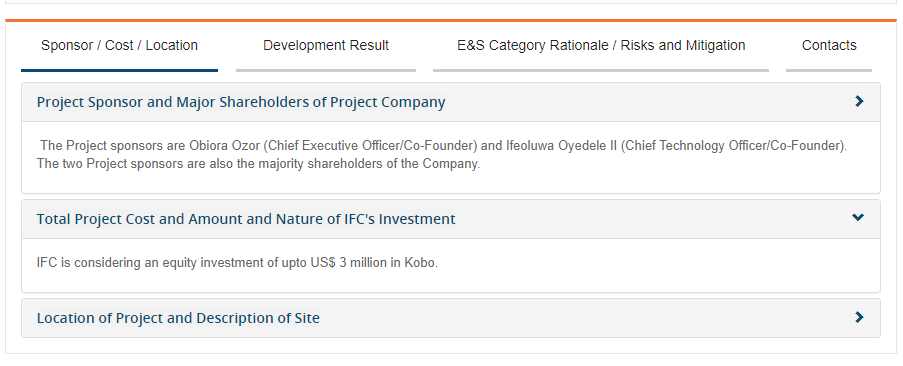
IFC is considering an equity investment of up to US$ 3 million in Kobo360 Inc (“Kobo”).

Kobo is a long-haul e-logistics B2B platform utilizing an “Uber for trucks” model to develop a marketplace matching cargo owners with long-haul freight needs and truck owners who are able to service them.

Through its internally-developed digital platform, Kobo is disrupting the transportation and logistics market in Nigeria offering a strong value proposition to key stakeholders in the sector including cargo owners, transporters (and drivers) and cargo recipients.

Kobo optimally matches demand and supply of trucks, providing predictability, reliability, price transparency, and increased utilization of otherwise idle assets in the highly fragmented trucking market in Nigeria.

Given the strong population growth expected (Nigeria will be the third largest country in the world by 2050), logistics will become even more important to support booming sectors such as manufacturing, agriculture, commodities, fast moving consumer goods (FMCG), etc.

Is Your Name On The AMCON List?

0

Nigeria’s AMCON (Asset Management Corporation of Nigeria) has released a list. It is a list of 105 people who (largely) owe the corporation. The list is unfortunate because AMCON is hoping that by publishing these names, the people would be shamed, and then pay their debts. What a strategy! Let me spare you the details (you can click here to see the roll call).

The Asset Management Corporation of Nigeria (AMCON) on Monday released the list of debtors it claimed have failed to negotiate successfully with the corporation.

The list, which contains about 105 names, came months after the asset management company said it would need the support of other relevant agencies to ensure that obligors pay up their debts.

The managing director and chief executive of AMCON, Ahmed Kuru, had in July promised to publish the list of delinquent debtors and directors who have failed to reach or refused to reach settlement resolution with the corporation.

Mr Kuru said after failed negotiations, AMCON would name, shame and embark on take-over of properties of delinquent debtors.

The big issue is the unbelievable nation we have: you have a man with a solid contact in a bank, takes loans beyond his capacity with yo-yo collateral, fails to pay and then the bank alerts the government through AMCON. AMCON rushes to the scene, takes over the loan and pays the bank. And then magically thinks it can manage the dying company which has been unable to service its debts obligations. In most cases, after years, the Nigerian people will lose money because AMCON cannot recover what it has put to “save” the private company.

Two things are happening:

  1. The bank did not do a good job by closing the flanks. They gave out a lousy loan, got the fees and when the markets could have punished them for not being thorough, government steps in to “save” the bank from its mistakes. The implication is evident: head or tail, the bank will win because no matter what happens, it will make money. If the loan goes well, it makes money. But when it does not, government takes over and pays it. As that happens, massive distortion happens in the market because the equilibrium point has been shifted for demand and supply to engage. If this is isolated and occasional, we could say it is a necessary way to save our financial system, but when you see this happening regularly, you would understand that even the banks are getting away with this.
  2. When AMCON arrives, it takes over the poorly performing company, after paying off the debts to the bank. But if you look critically, the businessman has moved billions of naira out of the company to buy houses in New York, London and beyond. AMCON leaves that guy alone, threatening it with a public shaming publication while leaving all those assets for that person. Tell me why the next person will not try to repeat this dubious way of transferring the commonwealth into personal purses. They know they can divert the money to other sources, and those companies they have funded with diverted monies will remain for them.

Simply, if banks know that bad loans can be taken over by AMCON easily, and the yo-yo businessmen know they can divert funds to other companies, without losing the secondary firms even though the original loan recipient firm is taken over by AMCON, there is no way this vicious circle will stop.  Nigeria will keep bailing bad habits until we get serious. Yes, the nation will keep paying Big Man Tax where everyone is paying to fund fake business deals in the economy. Nonetheless, I do agree that AMCON is adding value but it must be reformed to avoid this massive transfer of commonwealth into private purses!

Absolutely – AMCON is working but it needs to have a clause that if it comes and takes over, the bank will pay it on behalf of the Nigerian people 25% of the agreed sum while the loan recipients will lose rights to all global assets until everything has been regularized. By doing it this way, banks will have pains to deal with, and businessmen will think twice before putting our economy on risks.