DD
MM
YYYY

PAGES

DD
MM
YYYY

spot_img

PAGES

Home Blog Page 7065

Crises in Nigerian Stock Market as Investors Flee

0

Investors are increasingly losing confidence in the Nigerian Stock Exchange: market lost a total of N423 billion  ($1.3B) in one day, the highest in eight months. MTN Nigeria and MultiChoice challenges should not be uncorrelated with this as most foreign investors may be reaching the inflection point.

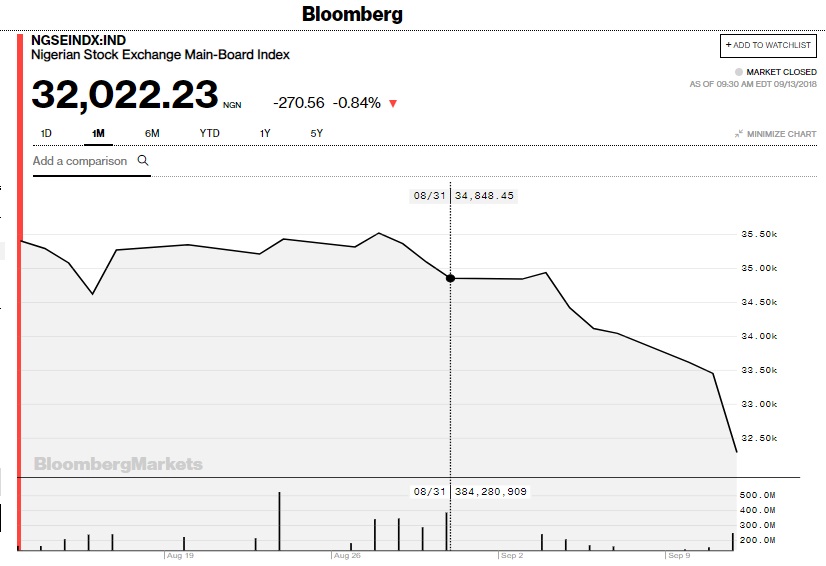
Following massive sell pressure on the equity market yesterday, the local bourse recorded its biggest loss in eight months, as investors lose whooping N423 billion in one day.

Analysts and operators linked the huge losses incurred by investors to the heightened political risk as the 2019 general elections draw closer on daily basis with the gale of defections without a clear economic plan or agenda to revitalise or boost the economy.

Specifically, at the close of trading on the Nigerian Stock Exchange (NSE) yesterday, All Share Index (NSE-ASI) shed 1,156.38 absolute points, representing a decline of 3.46 per cent to close at 32,292.79 points. Also, the market capitalisation declined by N423 billion to close at N11.789 trillion

I am getting worried now as if this bleeding continues, companies will trigger liquidity buttons, freezing major investments to conserve cash for who knows tomorrow. It could get very ugly that most Nigerian firms will start disengaging workers. If the stock market is battered and investments are muted, one thing happens: everyone withdraws, as pessimism sets in. Most times, workers pay the penalties.

While the fundamentals in the economy remain promising [bank profits are hitting record numbers], the political system is a weak point. That is affecting the sentiments of most investors and driving their asset allocation strategies. Some are moving into fixed income – making treasury bills hot. The implication is that most portfolio allocation decisions do not favor stocks right now in Nigeria.

Politicians have to wake up and help the nation. We are destroying this economy with the mass defection which shows lack of core values and principles in our system in building the nation. Where is the Country-First?
Fail Fast to Learn Fast

0

The four dilemmas of timing when to implement a business strategy.

Although we have become quite savvy about knowing whether an innovative idea is disruptive, we don’t really have tools for knowing when such disruption should happen, and when we need to get our organizations ready for it.

Indeed, innovative business often worry that they are evolving too slowly and will get left behind amid disruptive transformation. And yet, if business evolve too quickly, they risk losing followers, skipping over relevant stakeholders, or even pushing an irrelevant or irresponsible idea.

The following framework was developed by the Technical University of Denmark and sponsored by Brightline Initiative to help companies adapt internal resources for successfully timing their strategies.

[Apply] African Development Bank Unveils Programs to Study in Korea

0

From the Bank’s website here.

The African Development Institute of the African Development Bank has announced the implementation of the Next African Global IT Leaders Program under the aegis of the Korea-Africa Economic Cooperation (KOAFEC) Knowledge Sharing Program (KSP).

The objective of the program is to create a critical mass of highly trained professionals in ICT across the African continent at the level of Global IT experts.

The program is designed to expose mid-career professionals in African countries to the latest techniques and knowledge available through graduate studies at higher educational institutions in Korea, the announcement said.

Upon completion of their studies, the scholars would return to their home countries in order to apply and to disseminate their newly acquired knowledge and skills to enhance the socio-economic development of their countries.

This two-year Master’s degree program in Information Technology provides integrated courses focused on the IT technologies and strategies of Korea.

It also avails opportunities for networking with Korean IT industrial companies through classes and seminars; field trips to traditional sites to experience Korean culture and history; and on-site workshops at IT companies to take a view of the scene of Korea’s IT industry.

A rigorous student selection program is in place that targets employees in the field of ICT in public and private sector in the Bank’s Regional Member Countries. Applicants should additionally have the following qualifications:

  1. A certified bachelor`s degree in an IT-related area
  2. A certificate of English proficiency: TOEFL (iBT 83, PBT 560, CBT 220), IELTS 6.5, TEPS 599, TOEIC 720 or higher). These should have been taken at least two years ahead of the deadline of the application
  3. A public official, employee of public institutions or senior-level researcher at national research institutes working in the IT fields.
  4. This program is not available to Korean citizens, including Koreans who hold dual citizenship.

Please apply online on https://apply.kaist.ac.kr/intergradapply before 5pm on 14 September 2018 (Seoul time). Further details are available in the attached guideline.


The Best AI Book Ever Published in Africa; Download on Kindle,iBook, etc

0

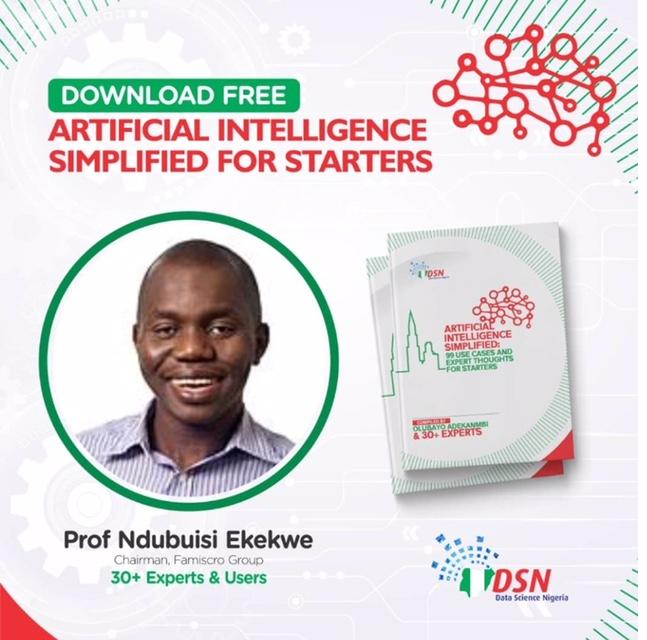
First, congratulations to all the contributors to the Data Science Nigeria’s AI book – Artificial Intelligence Simplified for Starters. It is the best AI book any person from our continent can read, to get a good idea, on how to enter a new technology trajectory which is expected to be as impactful as the invention of fire or electricity.

In this continent, we do not read a lot – yes, we talk more and that remains the key reason why Africans did not invent indigenous way of writing at scale (except Ethiopians) until the colonizers came. Notwithstanding, Artificial Intelligence Simplified for Starters received 10,000 downloads within 24 hours.

The consensus is that the book is generating AI energies across African communities, makerspaces, labs, schools and companies. Few hours ago, one of the readers sent me a note: “That was the best book foreword I have ever read; I did not know you studied history …”  [Fact: I did not study history please.]

DSN team has also been receiving feedbacks; one went thus: “with this understanding of AI possibilities, I can start my Machine Learning 101 with high sense of purpose, energy and what I can do with my learning and not just coding”.

The Next Phase

DSN is just starting. This is where you come in. It wants to make AL learning videos with local context and data. It needs your support. In this regard, DSN is providing a second download option via Amazon Kindle, Apple iBook, Kobo, Barnes&Noble etc at a donation of $2.99.

The PDF remains 100% FREE for download

The website communication on www.datasciencenigeria.org/aisimplified reads as below:

(1)    DOWNLOAD the BOOK as FREE PDF via https://goo.gl/QJio3W

(2)    DOWNLOAD via Amazon Kindle, Apple iBook at a donation of $2.99

You may also download the ebook via Apple iBook, Amazon Kindle, iKobo, Barnes & Noble and Scribd by donating $2.99 to support the work of Data Science Nigeria

Apple iBook                      https://goo.gl/2ZZBiH

Amazon Kindle                 https://goo.gl/aozMsb

Barnes & Noble               https://goo.gl/9mEuiS

Kobo.com                         https://goo.gl/7WYLLT

Scribd                                https://goo.gl/23zEzD

Please if you can, support – DSN is a registered charity and has done a great job in the community.

Full Requirements to List Your Firm in Nigerian Stock Exchange

1

Becoming a public company in Nigeria is not that hard as the national bourse has relaxed some of the most challenging conditions. The problem though is if Nigerians will prefer to invest in stocks or play MMM-incarnate or Bitcoin. Sure – the stock market terrified many minds in 2007 and 2008, and many retail investors are scared to return. If they do return, I can say that listing requirements are largely accommodating for some of the startups in the nation. Here are the requirements.


Companies seeking admission to the Official List of the NSE must, in addition to complying with The Exchange’s rules governing listing, comply with the relevant provisions of the Companies and Allied Matters Act 2004, Investment and Securities Act 2007 and the Securities and Exchange Commission rules and regulations, as well as any other relevant statutory requirements.
The NSE Rule Book sets out the requirements for listing on The Nigerian Stock Exchange. The table below provides a summary of the key listing requirements for the NSE’s Main Board and ASeM Board, as well as criteria for a dual listing. 

For details of the listing requirements, please refer to the NSE Green Book and the table provided here.