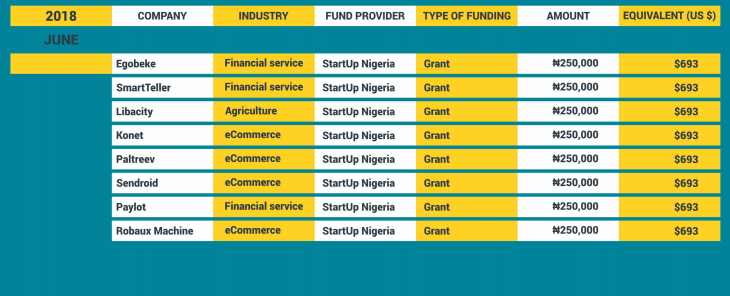
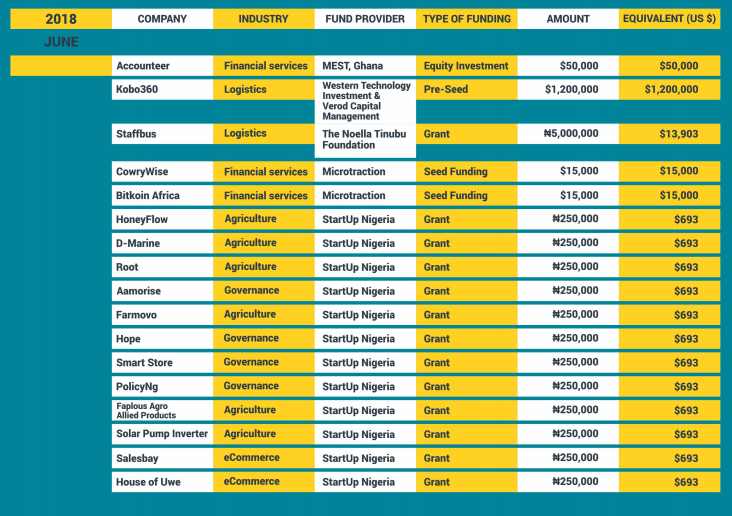
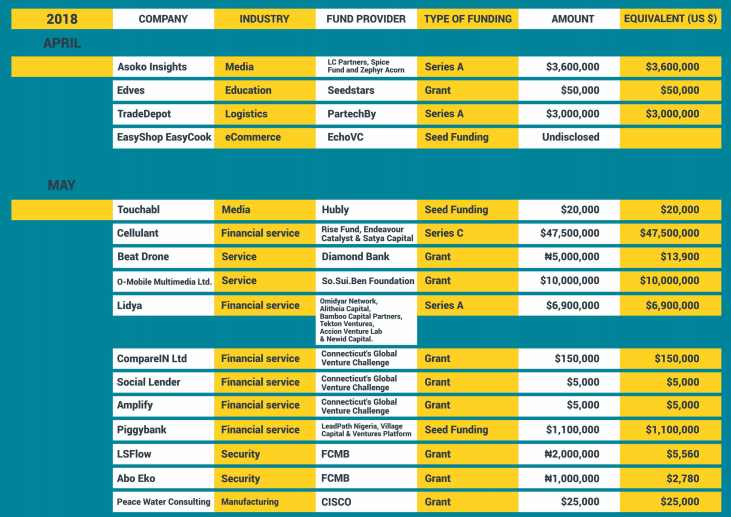
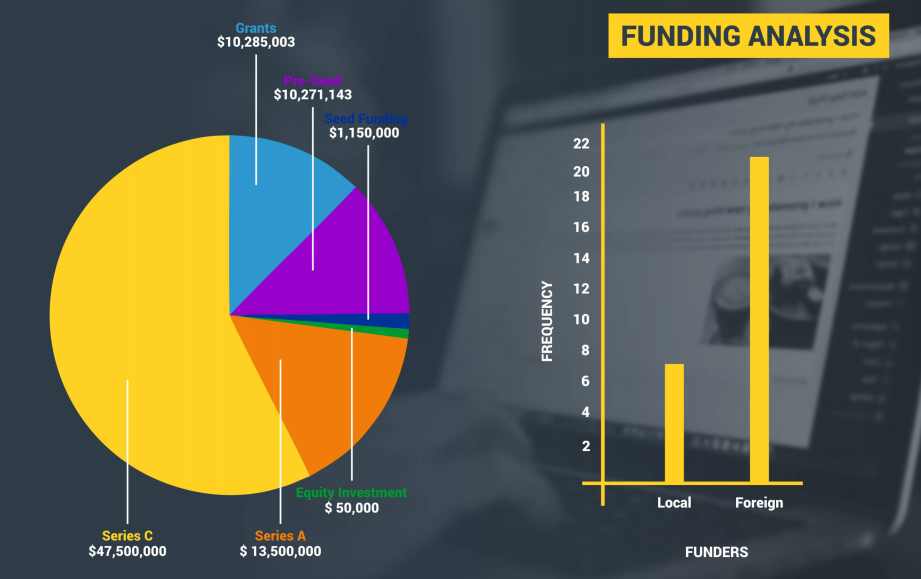
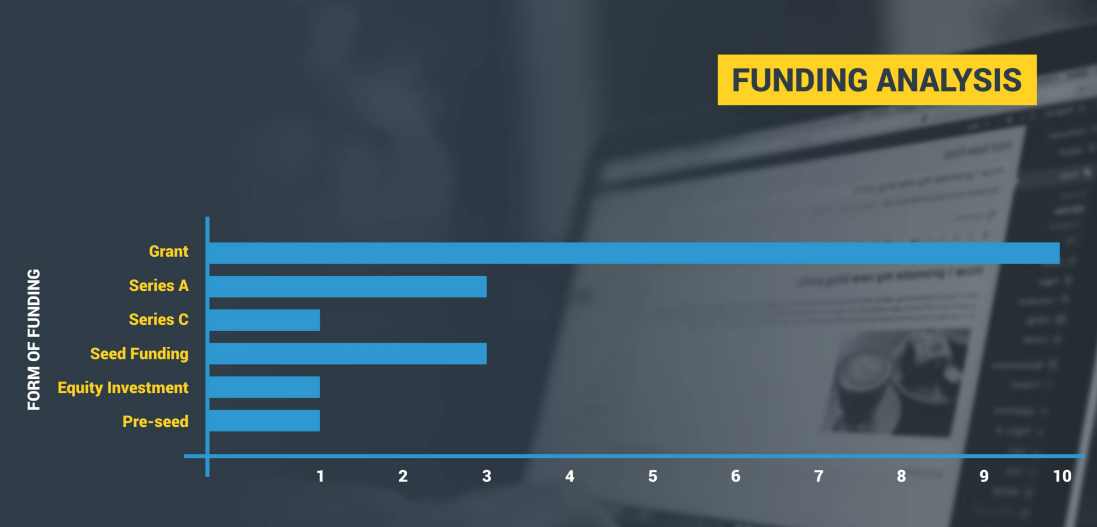
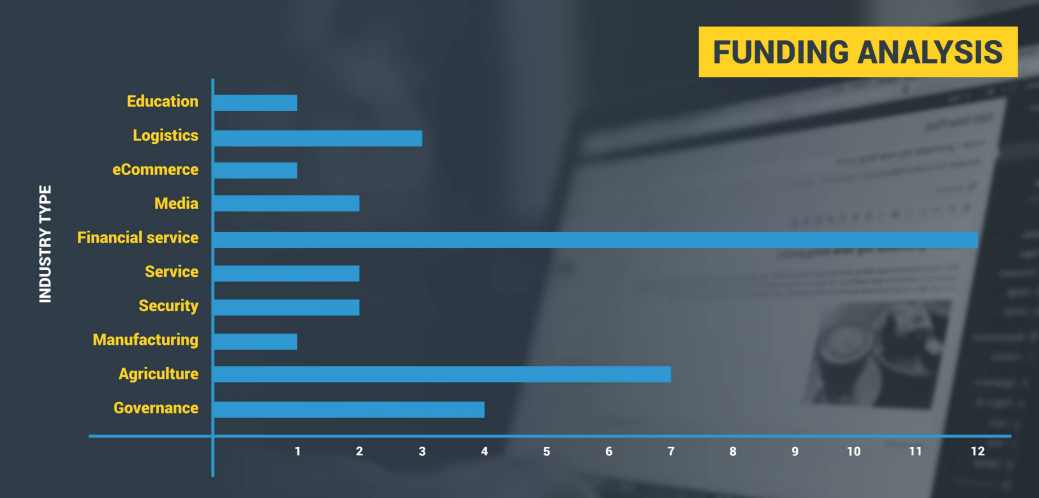
Nigerian startups are doing just fine in raising capital. Financial services technology (fintech) and agriculture technology (agtech) sectors are where the funds are going. The big cheques remain foreign while grants top the funding type (see plots below). Can you see FCMB funding security startups? Diamond Bank puts money in Beat Drone.
If you sum the whole money, the total raise was $73.6 million in Q2 2018, about 700 percent jump from Q1 2018.
Let me say this: everyone keeps missing the Tony Elumelu Entrepreneurship Fund which makes it data readily available online for anyone to pick the ones going to Nigerian startups. I think that should be captured as part of the funding volume. It is $10 million per year in Africa, and Nigeria gets at least 20-40% of that pile yearly.
Techpoint put this together and you can read the full report here (PDF).
My health-tech startup, Medcera, launches on Aug 1 2018. We are looking for Medical Officers of this company to be stationed across the nation. Medcera is American venture-backed but is totally Nigerian. I received funding from executives of JP Morgan Chase, KPMG USA, Boeing and other leading U.S. companies.
Our goal is simple: improve African healthcare delivery by simplifying the processes with technology. Medcera is absolutely free (unless you want minor brand customization) to doctors, clinics, labs, imaging centers, pharmacies, etc. We engineered a top-grade electronic healthcare record system with capabilities to connect to other healthcare nexus. Every patient has a portal to manage appointments, pay bills, chat his/her doctor, and more.
We make money through population-level AI driven health analytics which runs at the highest level of industry privacy and security. For example, Medcera can tell you how many people were treated for malaria yesterday in Nigeria for people in our network. That can help government plan. The era of guesswork in health policy-making is over. We can detect an outbreak in real-time.
The CMO will report to me (Chairman, Fasmicro Group) and would lead business development and partnership interfaces with the healthcare sector. Because Medcera supports labs, pharmacies, imaging centers and indeed all elements of the healthcare sector, we are looking for someone who has taken that Hippocratic Oath, Board-certified and yet humble to connect with others (potentially lower) in the healthcare chain.
The job will either be in Aba or Owerri (we are also looking at Lagos though). But since this is a cloud-based solution, we are recruiting partners/networks across the country for physical validations of any practitioner in our network.
If interested, please email job@fasmicrogroup.com with your CV. Please help me share with people in your network.
Medcera is an Africa-focused cloud-based electronic health record (EHR) platform for doctors, partners and patients, with a mission of connecting doctors, partners, patients and data to drive better health and save lives. The mission of the firm is to redesign healthcare in Africa through process innovations. Our platform streamlines person-centered care/case and disease management and drives appropriate resource utilization through interdisciplinary collaborative workflows, broad spectrum interoperability, patient engagement, and configurable analytics and reporting. Medcera empowers healthcare organizations to achieve enhanced outcomes while maximizing efficiency, improving transparency, and lowering costs. For more information, please visit Medcera.com (still on beta).
The Position
Provide guidance with regard to matters pertaining to clinical data, medical interaction, and health regulations as they relate to the company’s products and services.
• Provide operational support and serve as clinical advisor and educator to teams including sales and marketing regarding clinical and nonclinical events, clinical protocol development and design and evaluation of post market studies.
• Envision the application of new and existing technologies in novel ways to solve complex medical problems.
• Furnish advice regarding the specifications, usability, workflows, and procedures built into the company’s products and services.
• Identifies opportunities for leveraging technologies for improving patient access, quality metrics and manages outcomes through evidence-based metrics.
• Serve as a subject matter expert with regard to the usage, effectiveness, and suitability of the company’s products and services in various clinical settings.
• Participate in high-level meetings and discussions with representatives from health plans, provider systems, integrated delivery networks, physician associations, hospitals, employer groups, health agencies, international health organizations or any other healthcare organization.
• Engage with and support the company’s sales, business development, marketing and public relations effort.
• Collaborate effectively with other company executives and add value with respect to strategic discussions, product refinements, and key business decisions
• Keep ahead of emerging models in health care delivery.
• Identify and design new innovative strategies to achieve business goals and objectives.
• Develop and implement strategic goals related to quality improvement, management compliance programs and accreditation standards.
• Assist with analytics and development of quality measures for new payment models including value based/ risk based structures.
The Candidate
Established reputation with combination of medical and administrative/management experience in a clinical setting
• MD
• Current unrestricted license to practice medicine, and Board certified
3+ years clinical experience.
• Extensive contacts within the industry covering a broad range of healthcare organizations.
• Exceptional communication, presentation, and interpersonal skills coupled with a demonstrated ability to effectively express complex technical and scientific concepts.
• Comfort with the basics of IT and a high-level understanding of health information technology, including care management and population health management
• Publication and public speaking experience.
• Good understanding of quality metrics requirements and how technology can be used to monitor and improve metrics.
• Demonstrated success in establishing clinical best practices and care models to achieve value based care standards.
• Prior practice management, quality, data analytics and managed care experience.
• Excellence in scientific rigor and clinical development skills.
The Compensation
Competitive salary
Rapidly growing technology company with upside potential
If interested, please email job@fasmicrogroup.com with your CV.
We are looking for partners across Africa and some Nigerian states who can work with us in their countries or states to deploy Medcera at scale. Partners must have deep business development networks and contacts in the healthcare sector and with operational structures in their domains.
Medcera is a web-based EMR (electronic medical record) and EHR (electronic health record) system with patient portal. Our technology supports pharmacies, health insurers, labs, imaging centers, chemists, clinics, hospitals and indeed any entity in the healthcare sector. With Medcera, all the clinics and healthcare entities are integrated; if your data is in one clinic, it is also available in another clinic once you approve for the clinic to access it. We have made it possible that you do not need paperwork from one clinic to another. Medcera is backed by U.S. investors.
Medcera supports large and small clinics, dentists, labs, pharmacists, and imaging centers to move their operations into the digital ecosystems where they can increase productivity, lower costs on medical information management, improve quality of care and employee/patient safety. Also, Medcera offers health insurance solution enabling integration of physician, billing, insurance, government receipts and other components of health insurance delivery in one system, at private and public levels. All Medcera systems run on the cloud with no requirement for any installation. It is supported with bank-level security.
Key Features
Medcera Fusion:Free, web-based electronic health record (EHR) software for physicians and medical professionals. The EHR system includes medical charting, e-prescribing, clinical decision support advisories, online booking and scheduling, online referrals and messaging. Its lab, imaging, and billing modules integrate with a network of third-party laboratories, medical imaging centers and medical billing service.
Medcera Patient: Personal health record (PHR) system that gives patients access to their prescriptions, diagnoses and test results (as needed). Records update as physicians add information to their
patients’ charts. Consumers can search physicians by location and specialty, request an appointment and also pay hospital bills online.
Medcera Insights: An analytic product based on Medcera Fusion dataset of patient records at population level which is anonymized and aggregated. Real-time data provides perspective on clinical trends and helps with population health management and clinical decision support. Helps governments see disease outbreak as quickly as it happens. It is built with top-grade AI engine that improves population health.
Medcera Connect: A non-EHR designed for non-physicians structured for imaging centers, pharmacies, dentist practices etc making it possible for these entities to connect with Medcera Fusion. The goal is to provide full electronic interface with the EHR for any approved organization in the healthcare sector.
We would like to work with you. Email medcera@fasmicro.com explaining the country/state of interest with explanation on the depth of your network. Medcera is scheduled to go live Aug 1, 2018 on Medcera.com. We have started offering demos to major partners. You would be compensated for your business development services to Medcera.
Do not waste your time on music streaming business (music-tech). It has a lousy unit economics which makes it very challenging to attain profitability. Though video business is very technically challenging (those bandwidths and associated costs), music streaming business is terrible if you do it as the only business. But where you use it to sell hardware like Apple does, there is no issue. I have made this case before. The problem with music is the way you acquire the products. Unlike video which is not bounded to the number of users [you buy the rights and it is not tied to the number of people that watch the video], music pricing is directly linked to how many listen. It is the IP system’s fault which seems to protect music more than anything. But it makes music-tech entrepreneurs to be in challenging positions.
Running a business that streams video will always be a better business than one that streams music. The reason is simple: marginal cost. As I explain here, when you pay for video rights, it is uncorrelated to volume watched. But for music, your cost changes depending on the number of listeners. So, more listeners more royalties even though you may enjoy discount which improves unit economics. If a Zen master comes to you and offers these: take one of these startups – one streams video, the other music. Go with video. You have a better chance of scaling faster and making money. You see, you may need to take accounting class as your success can be bounded by unit economics even before you begin.
The upshot is, no matter how many subscribers they add, the companies will never enjoy the fat profits of other tech firms. Right now, the streaming services have yet to make any money and, if they ever do, it’s a safe bet the music industry will find a way to claw it back in the form of higher royalties. It’s much like the baker being totally beholden to a flour supplier that raises its prices every time donuts are on the verge of being profitable
Do not worry about Spotify, its market is different from Africa. It can keep losing money because it can keep getting new ones to spend. But where you need to build as we do in Africa with path to profitability, you cannot recreate Spotify easily. Spotify has lost about $1 billion in the last two years. It “reported a total operating loss of €41 million ($49 million)” in Q1 2018.
Spotify stock officially opened at $165.90 per share, fluctuating briefly in afternoon trading before closing at $149.01 per share. This closing price valued Spotify at $26.5 billion, which ranked it as the eighth-largest tech IPO after one day of trading, directly behind Google and and Snap, according to Dealogic. Since then, the stock has climbed as high as $171.23 per share and dipped as low as $135.51 per share.
Simply, this type of business (music streaming) will not thrive in Africa – no one will give you that kind of money to be losing. That was what brought Konga, a pioneering Nigeria’s ecommerce company which was sold, down! No matter how you see it, this is the summary of music-tech (streaming) business model: keep losing money!
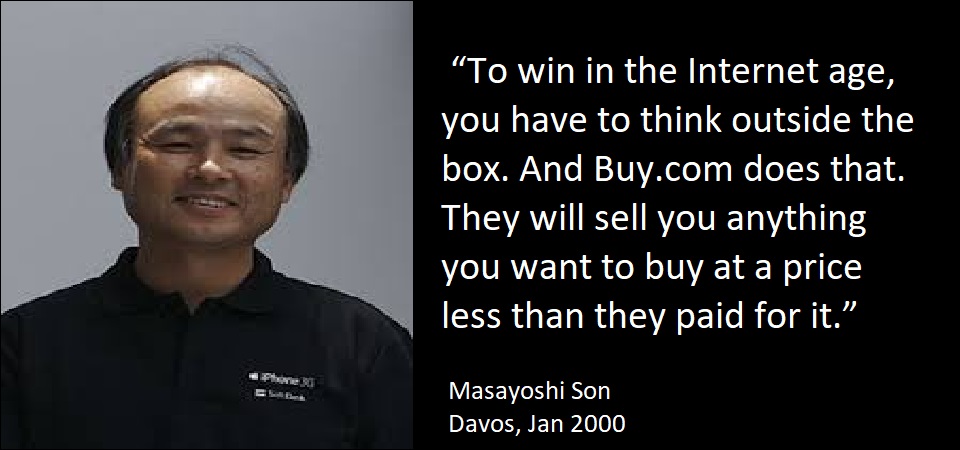
Buy.com later crashed. Of course Mr Son is a legend and a billionaire even though that one did not work
I recently read an interesting piece by Prof Ndubuisi Ekekwe on the record profit margin enjoyed by Airtel Nigeria even as ARPU dropped after adopting a new business model which effectively outsourced its infrastructure to partners whilst investing in customer service and experience.
For mobile operators, the Radio Access Network (RAN) accounts for 60% of its CAPEX while the electricity cost at the Base Stations accounts for 41% of the OPEX incurred per year. Hence, shifting this burden to partners is no doubt a good move for Airtel Nigeria and strongly highlight the need for telcos to keep innovating and developing new business models to stay ahead in this era of disruptive technologies.
The World Radio Congress (in 2019) will soon be upon us and the world awaits the flurry of early launches, tests, prototypes and spectrum debates. The race is on to ascertain which country will be the first to deploy 5G connectivity and some misconception are beginning to arise that the first country to deploy 5G will gain a global superior advantage. While this may not be true, China seems to be taking the lead as a result of its ‘Made in China 2025’ program.
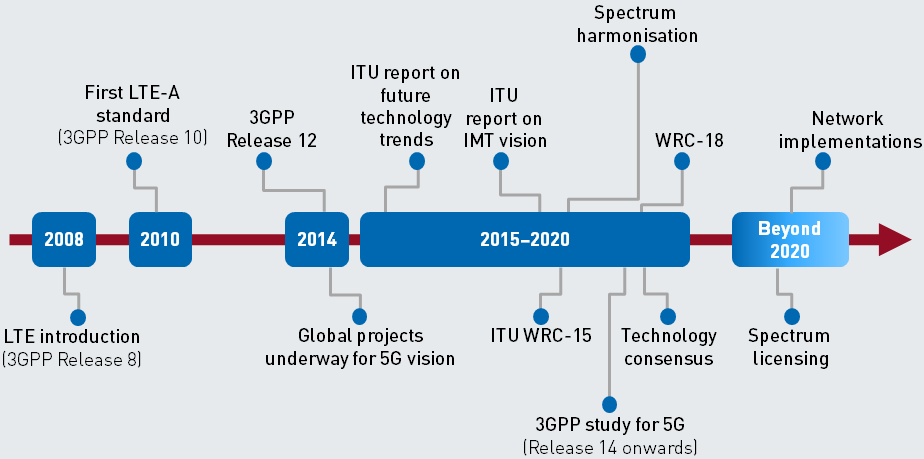
Timeline towards 5G [Source: Analysys Mason, 2014]Some of the key technologies that have been proposed for moving from 4G to 5G involve the deployment of small base stations or combination of network technologies (WiFi/LTE) for use within areas of high traffic region like hotspots, public areas, indoors etc. As 70%-80% of data traffic originates from indoor areas, it therefore makes business sense to focus infrastructural investment within these regions of high traffic demand. Clearly, this requires significant investment from telcos to meet up with the increased demand for data. Yet, customers are not willing to pay more as they are used to a flat rate system and want access to a seamless broadband usage, not to mention the stiff competition from OTTs. And the revenue from voice applications has reached a saturation point.
On the other hand, this is good news for equipment vendors as the 2018 market for telecoms infrastructure was projected to decline; 5G can certainly help change these predictions.
For telcos, the profit margins from consumer technologies no longer justify the huge investment needed to leap onto a newer generation. This sums up the notion that 5G would represent a shift from consumer technologies to industrial technologies. Verticals (in health care, factories, automotive industry etc.) thus represents a new market opportunity for telcos.
Network Slicing, Virtualization and Cloudification are being introduced within networks to cater for the different needs of the verticals and open up the potential for outsourcing models e.g. Network as a Service, Radio as a Service. Some telcos have expressed unwillingness in adopting outsourcing models as they would like to fully control their network but this may change in the future. These models however mean that the networks are becoming software based and may yet become another cloud service; hence it’s important for telcos to improve their capabilities in this regard;
Even though verticals represent new business opportunities, there are so many unresolved issues that need to be ironed out before telcos can justify the investment in 5G. Different verticals have different requirement and are in different digitization stages. The most obvious use case for 5G has been the automotive industry. But it is not sure if Car makers would be satisfied with slices of MNO networks or perhaps own and control their own network. Latency is a key requirement here as it becomes very dangerous if the car is waiting around and looking for the best signal reception to make a decision regarding collision. Standards, regulations, Global Harmonization of Bandwidth, Transparency, Security and Privacy concerns etc. have to be dealt with before any major deployment. According to ABI research, the automotive industry is nowhere ready to deploy 5G. In fact, Retail, Health care and Government etc. are the most promising sectors. This shows the lack of disconnect between service providers and the industries they intend to serve.
One thing is clear, presently, verticals do not represent a quick win for telcos. And there is no magic bullet regarding the choice of business model to implement. The best business model will need to be innovative, flexible and adaptable in response to the agile environment presented by disruptive technologies.