DD
MM
YYYY

PAGES

DD
MM
YYYY

spot_img

PAGES

Home Blog Page 7116

Nigeria’s Evolving Data Policy Will Destroy Startups

0
saraki buhari dogara

Today, we released a Data Risk Report to clients we offer advisory services in Nigeria: Nigerian government wants all telecom data to be stored locally. This is a very huge issue, as if government moves ahead, this can escalate to fintech, blogs, ecommerce and all sectors. Most Nigerian startups host their data outside Nigeria because the local alternatives are largely more expensive.

Yet, you may not blame the local hosting companies for being more expensive; they run generators and they hire their private security guards unlike their foreign counterparts. So, if this evolving mandate is enforced, many Nigerian startups would fold. It is evident that many would be unable to afford the rates of most local data center companies. This is going to become the biggest challenge for any Nigeria-based startup.

The House of Representatives has called on the federal government to mandate the Localisation of Data and Operations by Telecoms firms in the country in the interest of national security.

The house urged the Federal Ministry of Communications to take necessary action to address all undermining activities of the telecommunication firms operating in Nigeria by ensuring strict compliance with Data municipal laws.

This was sequel to a unanimous adoption of a motion by Chukwuemeka Ujam (PDP- Enugu) on Wednesday at the plenary.

[…]

He said that prevention was better than cure as it was not safe to leave such critical information in the hands of foreigners.

The Speaker of the House, Yakubu Dogara, mandated the Committee on Information Technology to ensure compliance.

I do hope government does not make this a blanket rule. Currently, one can get hosting services with $20 at JustHost or HostGator for a year [yes, it is crappy but it is a service nonetheless]. That affordable price has helped in expanding the number of web companies in Nigeria. But where the local hosting ordinance regulation plays, these small entities will disappear.

While Nigeria must work on its national security, the fact remains that Nigeria has to invest in some critical infrastructure before it makes some of these rules. Running a data center in Nigeria is not easy without constant electricity since you want websites to be available all the time. So, without light, you are essentially telling these small entrepreneurs to go first and raise thousands of dollars for local hosting which will involve buying big generators to power the servers. Many would not do that.

The Available Options

As I noted in a piece on data hosting in Nigeria, we have four main players: MainOne, MTN Cloud, Rack Centre and Vodacom. These companies are not necessarily priced for non-venture backed startups. For some, you need to have few thousands of dollars before you can begin. Many Nigerian startups would not afford the amount. While these hosting companies are evolving, they remain optimized for enterprise clients.

There are four main cloud providers in Nigeria – MainOne, MTN Cloud, Rack Centre and Vodacom. Two of these companies, MainOne and Rack Centre, have cloud services as one of the key components of their businesses. Sure, MainOne sells bandwidth, delivering connectivity services, but cloud service is a key business. MTN is known for its voice telephony and the broadband services, across Nigeria and beyond. Vodacom Nigeria is largely there to serve enterprise customers, since it is not operating any voice telephony service, yet.

For MTN, MainOne and Rack Center, which I have reviewed their cloud offerings extensively for clients, as part of my company advisory services in Nigeria, the data center technical capabilities are largely the same. They meet most of the industry top standards. However, the pricing model is totally different. (I will not get into which one is most affordable since they do not make their prices public).

Potential Implications to Nigeria

If Nigeria does not do the basic things before pushing this regulation across all sectors, it would simply make these startups to do what many have done in most countries where such laws have been put in place. Yes, many startups would just re-incorporate in U.S. and then pay U.S. taxes even though the customers are Nigerian customers. Provided the government does not block their IP addresses [they must block Netflix, Google, Facebook, etc before they could do so], nothing much would change. It is always harder to police digital companies unlike industrial-age firms with their lands and physical domains.

Besides, hosting is not just about space; it involves looking at companies with primitives and code libraries which can make developments faster. Working with AWS saves me thousands of hours because it has many primitives which I can adapt for my designs. If the local hosting firms cannot offer such [many do not], any mandate would not move Nigeria forward on the path of innovation. Yes, we would not stagnate because we are cut-off from the best in the world. So, I hope this law holds for only telecoms; they have the money to comply, locally!
The Cap Battle: Microsoft’s Platform, Google’s Aggregation

0
Google Microsoft CEOs

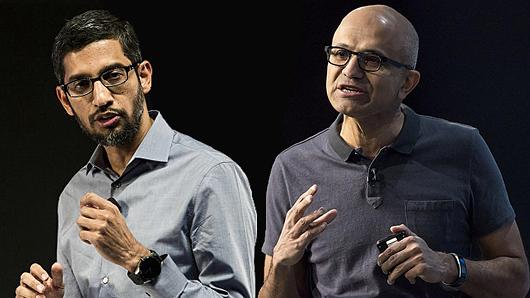
Right now, Microsoft market cap is $752.19 billion, and Google market cap is $754.58 billion. Few days ago, Microsoft overtook Google but Google has since recovered. These two companies are built on different technology genes – platforms and aggregation.

Microsoft is a platform where the sum of the derivable values for companies which use Windows are in many multiples more than the value of Windows/Microsoft. In other words, if you combine all the values which Windows, the best product of Microsoft and its One Oasis, has enabled across industrial sectors in companies that use it, those values are more than what Windows/Microsoft has gotten.

For Aggregation, you are talking of aggregation construct where the key is feeding on raw materials which you have not necessarily created by curating and managing the data, and from there, monetizing it. Aggregators bring order in a web that is unconstrained and unbounded with data sources.

Over the last few years, aggregators like Facebook and Google, typically advertisement-anchored, have created enormous value. In coming years, with new privacy rules like GDPR, many things could change. That could be the reason why people reacted and moved Microsoft ahead of Google.

The GDPR Regulation

GDPR (General Data Protection Regulation) is a new privacy rule [among other things], championed by European Union, will change many things in the EU and around the world. The freemium aggregators like Google would see more tension in their businesses with governments. This rattled some investors on aggregators which traditionally have lousy data privacy policies as they need data to run their businesses: Facebook cannot run ads without understanding users,  Microsoft does not need to know you to sell you Windows. In the table below, I provide major elements of key categories of aggregators.

Interestingly, this new rule would actually make aggregators like Google and Facebook uncontested winners since new companies may struggle to meet the draconian requirements governments have put in place. Yes, only the well-funded companies could comply easily with complex regulations.

Yes, they are fighting for us – to save us from our data which we willingly share with reckless abandon from getting into the wrong hands! But saving us would make it practically impossible to have any challenger to Facebook, Google, Twitter, etc in coming years. And many startups that depend on these ICT utilities would die. I had noted this in a piece in Harvard Business Review few weeks ago. Say it another way, by toughening data sharing, the regulations would kill competition, handing over the trophies to the incumbents in perpetuity. Yes, the option to build upon their existing infrastructures would be heavily curtailed.

[…]

The old web has been bidirectional system where Google and Facebook collect data and then share with others in their ecosystems. Today, that is gone. They have the rights to collect and keep. That is not going to make us better. I expect them to shutdown most APIs which many other entities have depended upon.

All Together

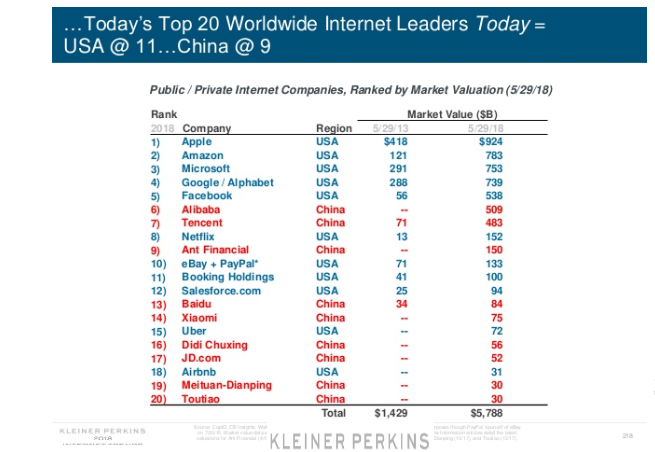
The GDPR will have real implications in digital businesses. And it is very interesting that the region (EU) promulgating it has no representative in the leading Internet companies in the world. Yes, EU has no company in the top 20 of the largest internet companies as noted by Kleiner Perkins Internet Trends Report 2018. If the rule stays without amendment, nothing will change. Whether it is platform or aggregation, they have one unique shared-feature, and that is scale. That scale comes from the positive continuum that marginal cost drops when you have many people using a digital product and the more the users, the better. You may think that using Windows 10 may not affect your neighbor, but the fact that further Microsoft investment on that product is based on the realization that people like the product. And with Cortana and Bing linked/integrated inside Windows, the implication is that it gets better with more people. That is what aggregators enjoy: they get better as they harvest more data which makes more people to find them more useful. So, provided Google and Microsoft are category-kings in their areas of services [they are], they would be fine.

2018 Internet Trends – Top 20 Global Internet Firms; US 11, China 9

2018 Internet Trends – Top 20 Global Internet Firms; US 11, China 9

2
Internet Trend Report

Here is the 2018 Internet Trends by Kleiner Perkins’ Mary Meeker. You may pay attention from slide 216 where you can see how China has cut into U.S. Internet dominance: Five years ago, only two of the top 20 internet companies were Chinese; now nine are, just behind the U.S.’s 11. Interestingly, no other country broke into the top 20! Talk of two superpowers and duopoly world.

In the 294-slide document, they mentioned “Africa” twice, both on footnotes, referencing an ITU data. Nigeria did not make it. Reading the document, it does seem like Africa is not even in the world. If not, how could the most authoritative Internet Trend document in the world which many funds depend to wage money on startups and companies could not make a page on Africa. Yes, we need to earn it – I understand that!


Internet Trends Report 2018 from Kleiner Perkins Caufield & Byers

Nigerian Startups Raised $9.3 Million in Q1 2018

0
Q1 2018 Nigerian Startup Funding Report

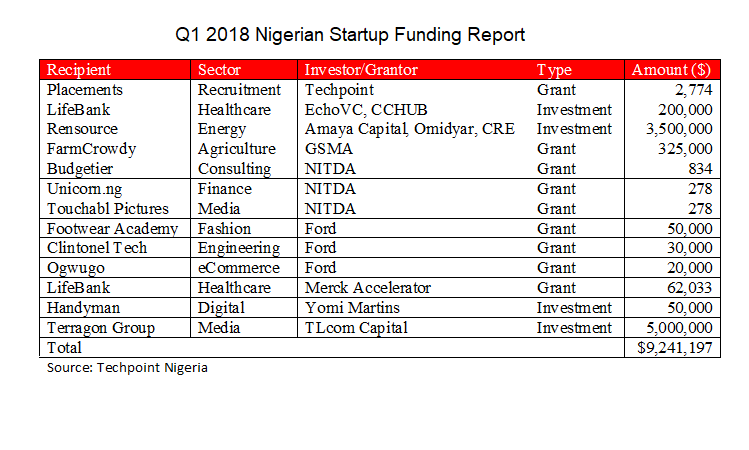
Techpoint has put together the Q1 2018 funding universe of Nigerian startups. The total is about $9.3 million. Q2 which covers April – June would certainly do better as many companies raised money in April.

The major purpose of this report is to make valuable data available to concerned stakeholders. The report, which is meant to serve as a quarterly overview, will be a buildup to an annual report and would help understand what is happening in such a vibrant and dynamic space. We believe these reports will provide a basis for stakeholders’ analysis and decision making with respect to Nigerian startups. We will try not to bore you with just numbers. The report will look into funding by types, industries, quarter-on-quarter growth rate (which will not be in the maiden edition) and more.

During the quarter under review, 14 startups got funding, more than 60% of which were grants. The total fund that got injected into the startup space for the quarter is $9,241,196 with Equity Investment accounting for more than half of that figure.

Certainly, this is not the full picture since many companies do not publicly disclose fund-raise success. Nevertheless, you have to work with what you have.

Q1 2018 Nigerian Startup Funding Report

My Schedule in the European Commission, Brussels, Next Week

0
European Commission

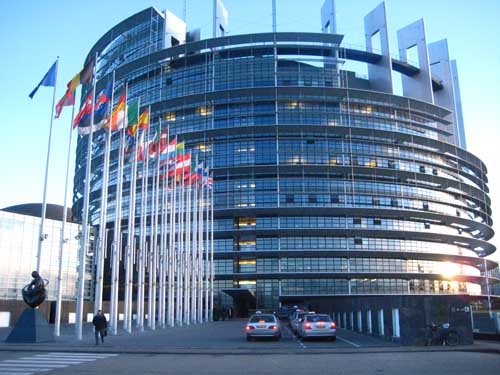
Beginning this weekend, I will be working in Brussels, spending time in the European Commission all through next week. During this period, I will be giving talks, speaking in panels and also telling people about Africa and the great nation – Nigeria.

On Monday at 11.30am, I will be on panel on the future of work with some policy experts from Oxford University, EU etc. On Tuesday, I will have my floor to speak on technology bringing the mix of academic, entrepreneurial capitalism and visioning capabilities.

By 2030, tech-savvy, hyper-connected millennials will represent 75% of the workforce, and older generations will work longer. Advancements in technology and automation are increasingly substituting both routine and cognitive tasks, while increasing the need for new skills and creating unprecedented opportunities.

They would tape it but most times, they do not share. I do not typically use slides or notes to give major speeches. I just start talking and as a Nigerian, it is only when NEPA takes light that I stop! Yes, no slide to share because I do not make any!

If you are in Brussels, InMail or contact my team via Contact Us, and we could connect.