

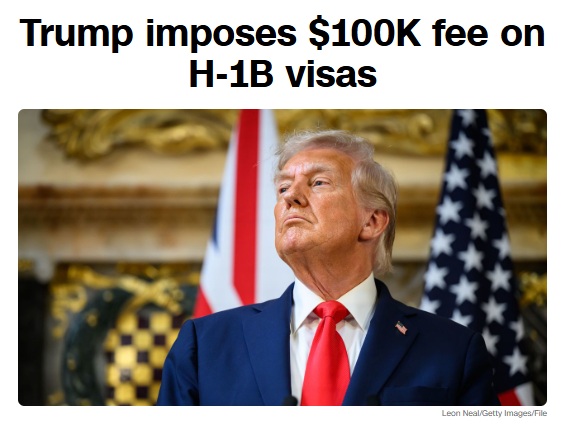
The Trump administration on Friday announced plans to impose a $100,000 annual fee on companies seeking H-1B worker visas, in what could be the most consequential shake-up to the program since its creation, potentially dealing a blow to the technology sector that relies heavily on skilled labor from India and China.
Since taking office in January, Trump has pursued an aggressive immigration crackdown, targeting both illegal and legal pathways. The H-1B overhaul marks the administration’s most high-profile attempt yet to reshape temporary employment visas, according to Reuters.
Commerce Secretary Howard Lutnick framed the move as a bid to prioritize American workers. “If you’re going to train somebody, you’re going to train one of the recent graduates from one of the great universities across our land. Train Americans. Stop bringing in people to take our jobs,” Lutnick said.
Register for Tekedia Mini-MBA edition 20 (June 8 – Sept 5, 2026).
Register for Tekedia AI in Business Masterclass.
Join Tekedia Capital Syndicate and co-invest in great global startups.
Register for Tekedia AI Lab.
The proposal comes against the backdrop of a tense relationship between the White House and Silicon Valley. Tech companies, which contributed millions to Trump’s campaign, view the H-1B program as critical to filling skill gaps. Critics, however, argue that it suppresses wages and sidelines qualified Americans.
Tesla CEO and former Trump ally Elon Musk, himself once an H-1B visa holder before becoming a U.S. citizen, has defended the program, saying it ensures firms remain globally competitive. Yet even supporters acknowledge the system has been exploited, with employers accused of holding down wages — a concern cited in the executive order Trump signed alongside the announcement.
Government data shows the number of foreign STEM workers in the U.S. more than doubled between 2000 and 2019, reaching nearly 2.5 million, while overall STEM employment grew by just 44.5%.

Pushback from Industry and Analysts
The proposed $100,000 fee has triggered alarm among venture capitalists and start-up leaders. “Adding new fees creates disincentive to attract the world’s smartest talent to the U.S.,” said Deedy Das, partner at Menlo Ventures, in a post on X. “If the U.S. ceases to attract the best talent, it drastically reduces its ability to innovate and grow the economy.”
The costs could pile up quickly: Lutnick said the visa would cost $100,000 a year for each of the three years of its duration, though he admitted the specifics were “still being considered.” Analysts warn the fees may push companies to relocate high-value work overseas, weakening America’s position in the fast-moving artificial intelligence race with China.
“In the short term, Washington may collect a windfall; in the long term, the U.S. risks taxing away its innovation edge, trading dynamism for short-sighted protectionism,” said eMarketer analyst Jeremy Goldman.

India and China Most Affected
India remains the largest beneficiary of H-1B visas, accounting for 71% of approvals last year, with China trailing at 11.7%. The new fees could therefore disproportionately impact Indian IT firms and outsourcing companies.
The biggest U.S. tech employers of H-1B workers also stand to be hit. In the first half of 2025, Amazon and AWS alone had more than 12,000 H-1B visas approved, while Microsoft and Meta each surpassed 5,000.
Lutnick insisted major firms are on board. “All the big companies are on board with $100,000 a year for H-1B visas. We’ve spoken to them,” he said.
The market reaction was immediate. Shares of IT services firm Cognizant, which leans heavily on H-1B workers, slid nearly 5%, while U.S.-listed Indian tech giants Infosys and Wipro each closed 2% to 5% lower.
The Legality Question
Aaron Reichlin-Melnick, policy director at the American Immigration Council, questioned whether the administration even has the authority to impose the new fee.
“Congress has only authorized the government to set fees to recover the cost of adjudicating an application,” he said on Bluesky.
Currently, the H-1B program allocates 65,000 visas annually, plus another 20,000 for advanced-degree holders. Employers pay only modest lottery fees, followed by several thousand dollars in processing costs, most of which are borne by the company. Visas are typically valid for three to six years.
In parallel, Trump signed an executive order creating a new “gold card” path for permanent residency — offering U.S. green cards to individuals willing to pay $1 million.
Weighing the Implications
Some analysts expect tech firms to absorb the costs, which will impact smaller firms negatively. Some believe that if Silicon Valley’s biggest players — Amazon, Microsoft, Meta, and others — choose to shoulder the fees, the industry may consolidate further. Start-ups and smaller firms unable to afford the $100,000 annual charge could be priced out of the global talent race, leaving the largest corporations with an even tighter grip on innovation. That dynamic could accelerate monopolistic concerns already under scrutiny in Washington.
There are also concerns that the new fee could result in work shifting offshore. For cost-sensitive companies, especially Indian outsourcing firms and U.S. IT service providers, the steep fee may prompt a shift of high-value work to countries such as India, Canada, or Singapore. That would blunt the administration’s goal of “bringing jobs home” and risk hollowing out America’s standing in cutting-edge fields like artificial intelligence, where China is moving quickly to gain an edge.
Last month, China announced it is set to introduce its new K Visa on October 1, 2025, in a move widely seen as part of its strategy to open its economy further and compete for global talent. The visa is designed to attract young professionals in science, technology, and entrepreneurship, marking a shift towards policies similar to talent visa schemes in the U.S., Europe, and Singapore, which have long been magnets for skilled migrants.
In addition, analysts note that the new fee will create a two-tier immigration system, with the launch of the $1 million “gold card” for wealthy immigrants. While highly skilled but less wealthy foreign professionals face steep barriers, ultra-rich individuals could buy their way into permanent residency. That dual-track system could further polarize the debate over who gets to build a future in America — and under what terms.
U.S. and The Global Race for Talent
While Washington debates ways to raise barriers, other nations are moving to lower them. Canada, long seen as the United States’ closest competitor for skilled immigration, recently launched a special visa program allowing U.S.-based H-1B holders to relocate north with minimal red tape — a policy so popular that its annual cap was met within 48 hours.
The United Kingdom has expanded its Global Talent visa to target scientists, engineers, and AI specialists, explicitly pitching itself as a hub for innovators who may find the U.S. less welcoming. Singapore, meanwhile, has introduced the Overseas Networks & Expertise Pass, offering five-year visas for top professionals without requiring a local sponsor.
This means that while Trump’s plan could make it prohibitively expensive for firms to hire global talent, rivals like Canada and the UK offer them affordable alternatives. Analysts warn that if the U.S. retreats from its historic role as a magnet for skilled immigrants, it risks ceding the next wave of innovation to competitors.