DD
MM
YYYY

PAGES

DD
MM
YYYY

spot_img

PAGES

Home Blog Page 6906

Finishing the Mission

0

They travelled around cities with their Master. They experienced great moments and accomplished great things. They saw miracles – dumb spoke, deaf heard, diseases cured, lame walked, etc. But when the Master was crucified and buried, they were disappointed. The master has left a promise: I will be back. And He could have expected them to be checking where He was buried.

No – they did not bother. They were disappointed because the physical presence of the Master was no more. The travels across cities had ended. And a great Friend was taken. The special people around the Messiah were now hiding. Possibly, going back to fishing may be an option, for some. In the midst of the disappointment, they forgot that promise of I will be back.

But the Master, legendary in His strategies on the Call to Mission had recruited great women as well, for the most important phase of the Mission – receiving and announcing the resurrection. Yes, the men – the disciples – may be down for the events on friday [you cannot blame them], but the women, though in pains, would not just give up, even to anoint the body!

It’s early in the D-day, the men were not to be found. But the women found the empty tomb and received the eternal message: “He has risen! …But go, tell his disciples and Peter…”

In business, as you build with the C-level executives (the disciples), make sure you consider the contributions which others can bring (here, the women). The message the three women passed from the angel to the disciples remains the heart of the Grace. Imagine if they were not involved – the reunion in Galilee might not have happened. They were not backups to hear “He has risen”– they are women who never give up, no matter the challenge.  That market is hopelessly gone, but they will say “we can still try something new”.

You need a complete team to finish a mission.


Reference: Mark 16:1-8


The Call to Mission

Linkedin Comment on Feed

It wasn’t by mistake that no human is self-sufficient, it was a design to value complementarity; and when neglected – things go awry.

If you are in a board or executive meeting and everyone always agree with your viewpoints, then you need to be really worried, the group could be on its way to damnation. You need one or two persons who do not see or think like you; they are your insurance, a dependable backup!

Most big events and decisions always come down to finer details, which usually escape the gaze of those with ‘big ideas’, you need those who care about the small things as well; they are highly invaluable. Importance is relative, because circumstance changes everything, making it possible for the ‘least’ person in the group to suddenly become the life-wire; do not neglect that.

In some circles, we talk about Authentic Informal Leaders, the real people that communicate company’s vision, making sure that everyone buys in. Real diversity captures all elements, not the type that is a product of political correctness or societal pressure; look deeper, to realise why things work so well in certain places. Any great mission must be a product of all encompassing team attributes.

Another comment

Women at work. The value of having the eye and heart of a woman is far beyond the ordinary. Who would have thought the men will be no were to be found? Sometimes the women have a lion heart.

Another Comment

It’s so inspiring thinking of how we can apply to business, the principles summed up in the live and choice of the greatest leader who ever walked the face of the earth hashtagJesus. It’s so instructive to know that the hashtagWomen held on to the master’s vision and believed it’s fulfilment, when the hashtagMen were unbelieving.

Muhammadu Buhari University … coming

0

Very soon, applications will be opened for Muhammadu Buhari University. Nigeria needs as many universities it can register. NUC is processing 303 at the moment; this new one will make it 304.

First Lady Aisha Buhari has expressed her plan to establish a private university to be known as “Muhammadu Buhari University”.

She disclosed this on Saturday during a town hall meeting in Yola organised by her in collaboration with concern indigenes of Adamawa.

Mrs Buhari, who did not however reveal when or where the university would be sited, explained that the university would be established in collaboration with partners from Sudan and Qatar.

Beyond 303 NEW Private University Applications in Nigeria, Quality Access Is Key

Lessons from Dubai, Singapore and Barcelona on Smart City for Africa

0

By Nnamdi Odumody

A Smart City is a city in which technology is a driving force in provision of smart services to its citizens. According to Mckinsey Global Institute, by 2025, cities will save up to $1.7 trillion a year delivering services if they deploy new digital systems on a large scale. As part of hosting the 1992 Summer Olympics, the city of Barcelona which is the capital of Catalonia in North Eastern Spain converted its abandoned textile district into a technology hub called @22 which is now home to dozens of startups, and laid a network of fiber optic cables which covers 310 square miles.

Twenty seven years later, it is Europe’s and the world’s most wired city. With an operating system that runs the entire city within one interface in place, different applications aimed at making the lives of its 2 million residents happier, it saves $58 million annually through Connected Water management, $37 million from Connected Street Lighting Solutions, reducing costs by one third.

According to Cisco, Barcelona will see cumulative economic benefits of 832 million euros by 2025, including 86.4 million euros in extra tourist spending. Its #1 tourist attraction, Camp Nou which is the homeground of FC Barcelona new stadium, will offer new revenue streams by linking fans directly to merchandising with free Wi-fi. It will also remove the fences around its 54 acre compound that attracts about 1.7 million tourists annually, creating a smart city neighborhood in the middle of Barcelona.

The Emirate of Dubai launched its Smart Dubai Initiative to make it the world’s smartest city by 2021. Between 2014 and 2017, Dubai launched 137 Smart Initiatives and 1, 129 Smart Services with 307,105 total downloads. It’s AVG happiness index in 2016 was 90 percent  with 30,123 questions asked in three months and 11 billion AE Dirham transactions same year.

The Government of Dubai between 2003 and 2015 saved $1.2 billion through smart services with $5.6 saved by them for every $1 spent on Smart Transformation. It’s potential value from IoT (Internet of Things) is $4.8 billion by 2020, $1.5 billion potential value at stake from government blockchain by 2020, $2.9 billion potential gross value added to GDP from Open and Shared City Data annually starting from 2021 (i.e $1,000 value per person in the city) while 100 percent Dubai government transactions will be on the blockchain by 2020. Dubai’s government will celebrate its last paper transaction by 2021.

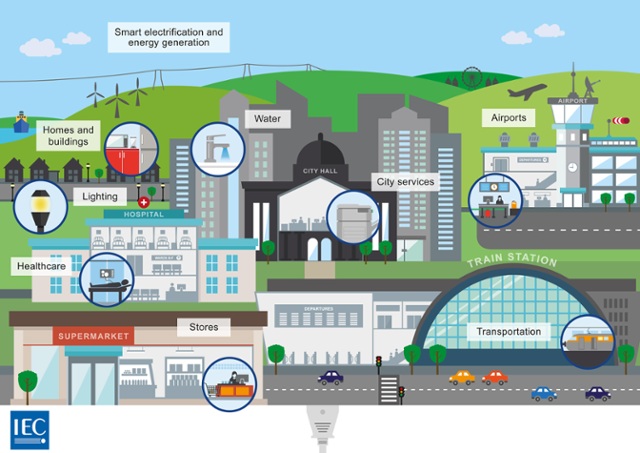
Components of Smart City (source: IEC)

The Smart Nation Singapore is the national effort of the government to remake the city state and its about 5 million citizens to embrace technology to make their daily lives easier, irrespective of age, gender, race and religion. It’s CODEX (Core Operations Development Environment and Exchange) is the digital platform that will enable the government to deliver better digital services to citizens faster and more cost efficiently. Its benefits:

  • Reusable digital components including machine readable data flows, middleware and micro services will be shared across agencies so that developers can plug and play into these resources and focus their time and energy on building better products to serve the public better.
  • The adoption of common tools and standards within government and by vendors will reduce bugs and raise the quality, reliability and security of services.
  • Government can tap into what the commercial cloud can offer in scalability and reliability as well as software services and tools.
  • This facilitates public and private sector to work together to develop more user centric services for the public.

The Smart Nation Sensor Platform is an integrated nationwide sensor platform to improve municipal services, city level operations, planning and security. More systematic use of sensors and data to improve urban planning, build more responsible and reliable public transport and better public security. An interconnected network of 110,000 lamp posts with wireless sensors will collate data that will be used for urban and operational planning, maintenance and response.

The Lagos State Government and other State Governments of the Federal Republic of Nigeria, Governments of Rwanda, Kenya, and Mauritius can learn from these three different experiences in adoption and implement smart initiatives and services to digitally transform their nations as well as enjoy the benefits of digital economies. Our continent needs to get 5G adoption and deployment right as it will be important in this redesign.

It’s Easter – the day of resurrection

0

It is Easter – the day of resurrection. I want to wish you all-around Easter in your life and career. As Heavens send angels on assignments today, may you be remembered to move from any valley in your life to the mountaintops. The grace, the amazing grace, and the abiding grace qualify you.

In mathematics, they call it exponential. In nuclear physics, they use quantum. I am combining them with wishes of exponential quantum blessing and breakthroughs. Today, no commercial-level computing can process that trajectory effectively. It is a huge gbaam – unbounded Miracle.

It is glory – overcoming the bounds of physics on this earth to experience the miracle of grace. As the mountains surround Jerusalem, so shall the grace this Easter will bring: total protection, total security, and total abundance.

Happy Easter

The Career Ladder – From Valley to Mountaintop

For Smarter Regulation of Airbnb in Africa

0

Hotels in South Africa are asking government to regulate Airbnb. They do think – allowing the hospitality platform to operate without regulations will eat into their business opportunities. DStv did ask for the same thing – regulation – against Netflix. Taxi owners did ask for the same element – regulation – against Uber. It is part of the new normal: get the technology portals out so that the old parties could continue!

Major entities in the hospitality industry in South Africa have called for government to step in an regulate Airbnb, according to a City Press report.

Airbnb has seen impressive growth in South Africa, and local hotels are concerned that the unregistered accommodation establishments listed on the platform are taking away business from established bed-and-breakfasts and hotels.

The Federated Hospitality Association of SA (Fedhasa) called for government to crack down on Airbnb, and smaller organisations have echoed this call.

The Port Elizabeth Metro Bed and Breakfast Association (Pembba) added that Airbnb brought in over R6 million in Nelson Mandela Bay last year, 65% up on the previous period.

The fact is that even if government regulates these digital platforms, the trajectory will not change because these platforms operate on near-zero marginal cost where the providers bear all the costs. The man that has a room to rent in Airbnb carries all the costs: no renter, Airbnb loses nothing! Largely, unless you ban it, no hotel can match that pricing because the man can always price lower than hotel chains as its cost model is more competitive. Airbnb will live on anything that comes to it because its cost is close to zero.

So, the shout for regulation will not change anything unless the hotels want to ban Airbnb in the nation. Doing that will be unfortunate since Airbnb provides income-earning opportunities to many citizens of South Africa who have rights to free enterprise as the hotels. By October 2018, South African Airbnb providers had made real money from Airbnb since it launched in the country in 2008. So, this cannot be structured for the hotels to be the sole winners. Others are indeed making money from South African tourism with their properties: “Findings released during Airbnb’s Africa Travel Summit found that South African Airbnb hosts have earned over R4 billion [$290 million] since the platform was founded in 2008, the Sunday Times reports.”

Regulation must be designed to support the South African tax base, leaving markets to decide who wins – hotels or Airbnb providers. So, charge Airbnb hosts the same tax rate you charge hotels and collect all the fees proportionately to track the hotels’. Once you do those, allow market forces to do the job. It is very possible we may not even need hotels in the future, and if that happens, let it be. But do not stunt Airbnb through arbitrary ban. Be fair and let customers decide the winners.

Why Airbnb Struggles In Nigeria

LinkedIn Comment on Feed

The good news about these stuffs (Airbnb, Uber Facebook etc )is that my House, Cars, Phones/laptops etc which could have just been liabilities can be transformed into Assets and bring incomes.
Since what they do solely is to close the gaps between potential services suppliers and services buyers, they play role of income redistribution.

Government area of interest should be on Tax generation and security/safety of the citizen (host and the guest).

Meanwhile Investment of companies in the Hotels, Printing and Logistics businesses needed to be protected because of the fact the established business are real employers of labour. I will suggest that Government therefore put higher Taxes on both Airbnb and the host to save the economy.
Since Airbnb operate at near zero cost, they can always operate at profit. Let them pay higher Tax. The host bears the cost.

The big players are on the receiving ends because of their huge operating costs and admin cost which make their cost high.

The game has already entered Printing business in Nigeria. The software company makes money from the buyer and also charge the printer for using their platform. It is challenging!

Another Comment

The only confusion here is that the Hotels Associations have not told us what exactly needs to be regulated: pricing or business model? It’s a different thing asking the government to save your dying business, in that case – you have the right to do so; but also note that you cannot always get what you ask for.

If we believe in free enterprise, both hotels operators and Airbnb providers are out there to make money, the only thing government should care about, aside from safety is how much comes in as taxes; anything else is more or less a harassment.

Lobbying is fundamental part of political governance, so as Hoteliers lobby the government, the Airbnb providers should also lobby; no one has a superior argument, it’s all about how you see it.

Again, we will always need the big hotels, for various purposes, beyond lodging, you cannot have big conferences or functions in Airbnb provider’s apartment; so the hotels will always be there. Since hoteliers cannot compete in bed and breakfast prices with Airbnb providers; they should reinvent their business model and shift more attention elsewhere.