DD
MM
YYYY

PAGES

DD
MM
YYYY

spot_img

PAGES

Home Blog Page 6957

Nigeria’s Biometric Nation as JAMB Introduces Biometric Capture for Exams

0

Good news from JAMB (Joint Admissions and Matriculation Board) as it sees more young people aspiring to attend universities in Nigeria: “Meanwhile the bulletin also noted that the slash in the UTME fee by the federal government had increased the number of candidates who want to sit for the examination.” Very happy for the voices we put together for the action effected for that change.

That said, the plan to use biometrics in JAMB exams will set a new basis for universities and all tertiary institutions in Nigeria to do so. After all, what is the value of JAMB using biometrics if the universities cannot use same biometrics to validate that incoming freshmen are the same JAMB had tested. So, as JAMB marches ahead with biometrics, contractors are already smiling because universities will need same equipment. Had NIMC (National Identity Management Commission) been fully operational, Nigeria could have consolidated all these disparate databases in one.

The Joint Admissions and Matriculation Board (JAMB) says it will not rescind its decision on the use of biometrics in the conduct of its Unified Tertiary Matriculation Examination (UTME).

This is contained in the board’s weekly bulletin issued on Sunday in Lagos.

According to the bulletin, the importance of biometrics in the conduct of the board’s examination cannot be overemphasised.

It noted that the Biometrics Verification Machine (BVM) was introduced by the board in an attempt to get rid of the numerous forms of examination malpractice.

It said the BVM was a security mechanism used for the authentication of candidates’ identity as it provided access to the individual data, based on physiological characteristics.

We need to fight exam malpractices, and using biometrics will surely help JAMB. Yet, it does not end there. The problem is that every university, polytechnic and college of education will get in line, embracing biometrics. And just like that, personal bio-data becomes permanently warehoused in schools which are not specifically suited for such. One will hope that brokers will not pay to trade on them!

Then after schools, employers will do their own biometrics to confirm that the same student is the very one applying for jobs.

Certainly, government needs to get NIMC going to avoid this biometric paralysis in the nation. It does not need to be this way. Yes, Nigeria cannot be a biometric nation, from telecoms (SIM card) to banking (BVN), and now university entrance exam, you do not need to kill more than one tiger to be nicknamed “the killer of tigers”.

LinkedIn Comment on Feed

Isn’t it ridiculous that in a country that is hell-bent on centralising governance now abhors the very things that actually deserve centralisation? We are really specialist in doing things the opposite way.

We run a federal system that is actually unitary in practice, then we have the NUC lording it over all the universities. You have the ASUU as a bargaining conglomerate, then we have JAMB deciding who the universities admit. With all the unification conglomerates all over the place, even when they are really the problems, we have done everything to keep them alive and kicking, while showing contempt and disdain to any idea that questions their efficacy and usefulness.

On the other hand, Immigration Service is maintaining its own database and biometrics, FRSC have theirs, the banks have their BVN, the telecoms have theirs, INEC is there, even Customs have theirs; and in all of these paralyses, we still have a certain NIMC, with government paying salaries there, only God knows what its job actually is. Now JAMB wants to join the league of Biometrics Keepers Association of Nigeria…

Other than awarding contracts and getting kickbacks, no one else can explain why we need disparate databases to keep an individual’s biometrics.
How Facebook’s NG Hub Accelerator is Promoting Nigeria’s Startup Ecosystem; Details of Major Startups

0

By Nnamdi Odumody

Social media giant Facebook unveiled NG Hub, in Lagos Nigeria, in 2018. The NG Hub was its first flagship community hub space in Africa. It is partnering with Co-Creation Hub, a community innovation lab, and will help to train 50,000 Nigerians on digital skills.

Besides, the Hub came with the launch of FbStart Accelerator Programme, a research and mentorship-driven six months programme aimed at empowering startups and students with $20,000 in equity free funding. Also, it provides technical and business mentorship from Facebook and CCHub’s network, an office space with internet, access to Facebook, and partner credits to optimize their growth.

The Hub also does Virtual Acceleration for student teams (Bsc, Msc or PhD) working on transforming their ideas or research into working prototypes with equity free funding of $5,000( Bsc), Msc($10,000) and PhD($15,000) along with technical and business mentorship, an office space with fast internet at partner hubs scattered across the country, free credits from Facebook and product credits. Largely, the focus is on those building solutions using artificial intelligence, machine learning, augmented and virtual reality.

The following startups are currently working with the FbStart Accelerator programme in Nigeria.

ARTIFICIAL INTELLIGENCE

RoadPreppers:  Founded by Samuel Odeloye which has developed Lara.ng, a chatbot for public transportation which gives information on routes, estimated cost of transport and time, helping citizens to plan daily movements properly.

Say Peace: Founded by Salisu Gaya which uses machine learning to monitor, detect, and analyze hate speech on social media in real time to prevent violence in Nigeria.

Vertsark: A web based platform which uses machine learning to predict, prevent and manage disease outbreaks for the benefit of livestock farmers, veterinarians and public health. This team won the Google Project Enable Challenge Prize of $250,000 for Social Entrepreneurs making impact.

Plantheuse: This uses artificial intelligence to diagnose plant diseases and suggests solutions to farmers and agric extension workers.

DeepQuestAI: Moses and John Olafenwa launched Deepstack, a suite of dockerized AI server software that enables developers to easily build, deploy and manage AI powered applications on their private servers and edge IoT gateways.

Insyt: Founded by Ofoedu Frank Ebuka is a data analytics platform which uses AI to collect real time data from social media for businesses, helping them know the public perception of their brands, and allowing them to keep track of online conversations about their brands and products. It is supported in English and pidgin, and works to measure the impact of marketing campaigns, interactions with customers and gathers valuable consumer insights.

Chiniki: Guard founded by Abdulhakim Bashir is a monitoring analysis and reporting platform for security cameras, using AI to estimate human poses, and to detect suspicions activities (like shoplifting and theft) in retail stores.

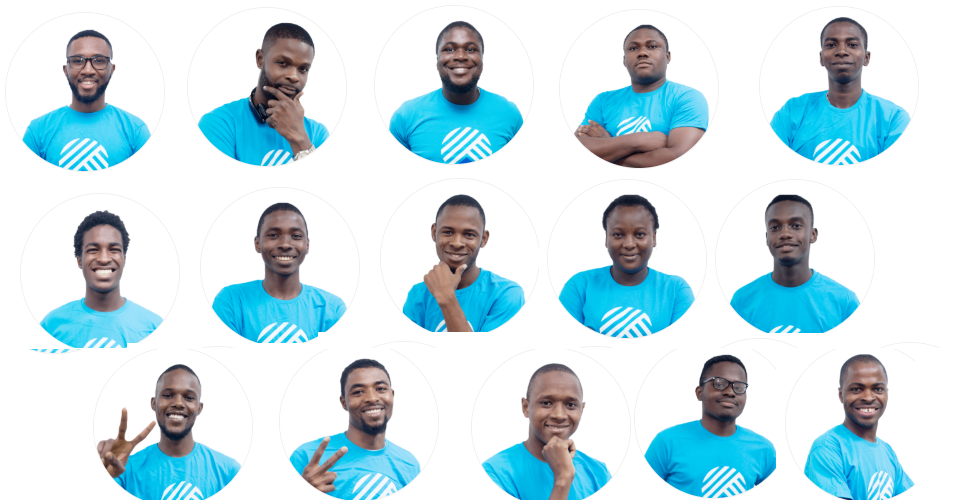
FBStart NG Project Leads

INTERNET OF THINGS

Gricd: Founded by Oghenetega Iortim and Richard Aimola; they developed Gricd Frij, a cold chain box for storage and transportation of temperature sensitive items like food, blood and vaccines at regulated temperatures of up to 20 degrees Celsius with real time storage temperature, and location monitoring technology and battery, which lasts up to 48 hours.

Cycles: Founded by Damilola Soladoye is a bike sharing company which uses smart bikes for bike sharing, redefining how people commune in private estates, universities and other gated communities to create sustainability and reduce carbon emissions for a greener earth.

Trep Labs: Founded by Taofeek Olalekan which has developed RealDrip, an IoT solution which prevents back flow of blood during drip treatment by monitoring flow rate, volume administered, and automating the process.

UpNepa.ng: Founded by Salaudeen Abdulrahman is an IOT powered platform that monitors, records and predicts electricity supply.

Smart Electricity: Founded by Livinus Ezeh is using wireless electricity to power appliances in homes and offices.

VIRTUAL REALITY

Project Move: Founded by Tade Ajiboye, it is a VR accessory which significantly improves immersion and interaction in mobile driven VR systems.

Quadron Studios: Founded by Uche Anisiuba which has developed QVES, a Virtual Reality Safety training solution that prepares enterprise workers for emerging situations by the use of immersive virtual training experiences.

Kainji: Founded by Damilola Okelana, it uses VR to teach users how to drive and be road aware.

Another startup in this programme worthy of mention is Doctoora, a platform which makes it easy for medical practitioners to engage in private healthcare practice, outside the confines of their primary places of work, by aggregating space capacity (like clinic spaces, consumables, physical facilities, workforce, wards, theater, dialysis, and diagnostics) across standard health facilities, and rent out to users on a structured payment basis.

Two Nigerian Brothers On A Quest To Democratize AI for Everyone


Why Market Integration Is Critical In Business Success

0

One of the most important elements in technology ventures is efficient integration of market systems. In short, most times, companies win based on the quality of integration into customer ecosystems. Integration is a key component of business model, and does matter a lot, on differentiating consumer-focused and enterprise-focused businesses.

A consumer-focused business (e.g. Facebook, Nairaland) builds its integration to serve mass-produced solutions. Usually, the best solution in the sector is adopted massively by many users, and over time, it wins the market. An enterprise-focused company (e.g. IBM, ATB Techsoft) delivers solutions to companies but must customize them to meet the specific needs of the enterprises. Doing that means that winning is no more just about technology, but support, sales force, and capacity to close deals and sign contracts.

Facebook is a consumer-focused company. It has built its integration to focus on making the best product that serves mass market (of customers). These products are largely uniform.  It does not have to customize anything from one user to the other. The marginal cost in the business is very low – distribution is non-convoluted – and it can just scale really fast because it does not need to have many sales people.

But when it comes to IBM which is mainly an enterprise-focused company, the products, though similar at core, are designed to be customizable for customers in order to meet their specific business technical frictions. It cannot just expect the web to do the job. So, it needs to have sales force, contract team, etc for it to thrive.

The implication is that the architectures of Facebook and IBM businesses are different because the customers they serve are different. If Facebook wants to start doing enterprise business, it will fail before it restructures its system to become like a company that can support companies. Similarly, if IBM wants to start doing consumer business, it will struggle until it recalibrates to become like a consumer-focused company. Those changes are at the heart of integration – linking solution value into users to solve their frictions. The value could be connecting with friends (Facebook) or implementing a new database (IBM).

This is the reason why great companies like Google, a leading consumer-focused business, will struggle when it moves to enterprise-market. Think of Google Cloud where it continues to struggle as Amazon AWS and Microsoft Azure leap ahead. Google will be fine, but to do that, it must build a sales team which is not typical in Google in its consumer search-driven business. The realization has not much to do with technology: Google does have extremely great cloud technology with many suites. But that is irrelevant: its integration does not fit the ways it can deliver value to enterprises.

You will say the same as why Microsoft has struggled on leading any major sector in the consumer business: it is a company wired for enterprises, working with OEMs to bundle Windows in laptops and desktops. It was never in the business of dealing with end customers at scale. Bing is there but it continues to struggle while Azure became a runaway success because Azure is just like Windows – an enterprise business which Microsoft understands.

All Together

Integration is at the heart of a business model. Most times, the way a company is structured affects its capacity to win. Even when the competing product or technology is at the same level of quality, the integration system with customers is what really determines success.

Google Cloud is just as good as Microsoft Azure but the business model of Google has not been well integrated to serve enterprise customers, leading to Google Cloud struggles. Similarly, Microsoft despite any great technology it can make is yet to understand how to do consumer business at scale. So, Facebook, for instance, can go enterprise but it will struggle until it re-integrates, since its current integration is biased for consumer business.

The message is this: as you build, understand your market so that you can have the right integration with your customers. It is only when you get integration right that you can deliver higher level of values to the business frictions of customers. At that equilibrium framework, your reward will come: business success.

LinkedIn Comment on Feed

Hello, Ndubuisi Ekekwe, This is particularly true as there’s a very distinct customer journey between B2B and B2C. Apparently, only the right integration can help businesses (B2B or B2C) deliver a customer experience that move hearts and wallets.

The Aggregation-Integration Construct

Nigeria’s Olafenwa Brothers – Amazing AI Geeks With Vision

0

Hello Moses Olafenwa and John Olafenwa,

This is Ndubuisi Ekekwe, your fellow citizen. I read a post on my blog written by Nnamdi. I was blown away by your work.

Moses and John Olafenwa, the CEO and CTO of AI Commons (now called DeepQuest AI), respectively, launched Deep Quest AI to advance artificial intelligence and make it accessible to every individual and organization in the world.

They created Deepstack, an AI server which can be easily installed, used completely offline or on the cloud for facial recognition, object detection, scene recognition and custom recognition for enterprise, consumer and security applications. Its API allows you to run thousands to millions of requests without pay as you use costs, and provides the perfect integration channel for all your applications. Also, it makes it easier to add new recognition APIs at will, with capacity to deploy instantly with strong user privacy.

Quickly, I marshaled to track both in Nigeria and within minutes, I spoke with Moses. I offered jobs to start on Monday but Moses “smiled”. I offered to fund your ideas immediately, Moses “smiled”. Because that happened, your story becomes more exciting: jobs and money serve great people! You both are amazing.

I told Moses that I will make this post to show young people the way the world works. I wish Moses had given me the opportunity to sign the offer letters or write the cheque. Nonetheless, your story is what Nigeria needs.

Good luck into the exciting future. You have my direct phone number!

Two Nigerian Brothers On A Quest To Democratize AI for Everyone

Two Nigerian Brothers On A Quest To Democratize AI for Everyone

7

By Nnamdi Odumody

Moses and John Olafenwa, the CEO and CTO of AI Commons (now called DeepQuest AI), respectively, launched Deep Quest AI to advance artificial intelligence and make it accessible to every individual and organization in the world.

They created Deepstack, an AI server which can be easily installed, used completely offline or on the cloud for facial recognition, object detection, scene recognition and custom recognition for enterprise, consumer and security applications. Its API allows you to run thousands to millions of requests without pay as you use costs, and provides the perfect integration channel for all your applications. Also, it makes it easier to add new recognition APIs at will, with capacity to deploy instantly with strong user privacy.

Many developers around the world currently use their solutions and they provide extensive and comprehensive tutorials for developers, machine and deep learning engineers and researchers. Their technologies, tools and knowledge are available to individuals, teams, organizations and institutions across the globe in English, Chinese and French languages.

Through ImageAI, a game changing product from their stables, they have created a computer vision library which empowers developers to easily integrate state of the art artificial intelligence features into their new and existing applications and systems. This solution is used by many developers, students, researchers, tutors and experts in corporate organizations.

ImageAI is a python library built to empower developers to independently build applications and systems with self-contained Computer Vision capabilities. Built with simplicity in mind, ImageAIsupports a list of state-of-the-art Machine Learning algorithms for image prediction, custom image prediction, object detection, video detection, video object tracking and image predictions trainings. ImageAI currently supports image prediction and training using 4 different Machine Learning algorithms trained on the ImageNet-1000 dataset. ImageAI also supports object detection, video detection and object tracking using RetinaNet trained on COCO dataset. Eventually, ImageAI will provide support for a wider and more specialized aspects of Computer Vision including and not limited to image recognition in special environments and special fields.

It provides API to recognize 1000 different objects in a picture using pre-trained models that were trained on the Image Net-1000 data set. The model implementations provided are SqueezeNet, ResNet, Inception V3 and DenseNet. It also provides API to detect, locate and identify 80 most common objects in everyday life in a picture. Also, its extended API helps to detect, locate and identify 80 objects in videos and retrieve full analytical data on every frame, second and minute. This feature is supported for video files, device camera and IP camera live feed. New image recognition models on new image datasets for custom use cases can also be trained with its API and also provides implementations to integrate and deploy the custom image recognition models.

Another game changing product is Torch Fusion, a modern framework built to accelerate research and development of advanced deep learning systems. It provides a complete platform for loading datasets, defining metrics and models and training them with extensible trainers that can be seamlessly customized with custom training logic all with full support for training on both CPUs and GPUs. Torch Fusion provides applications and extensible specialized trainers for a wide range of conditional and unconditional Generative Adversarial Networks which are state of art for image generation.

All Together

Africa and especially Nigeria must support inventors like Moses and John Olafenwa to scale their missions and position the continent, solidly, on the path of AI future. Heralded to be as impactful as the invention of fire, AI will have real implications for markets and industries. Young people like Moses and John offer huge promises, and must be supported.