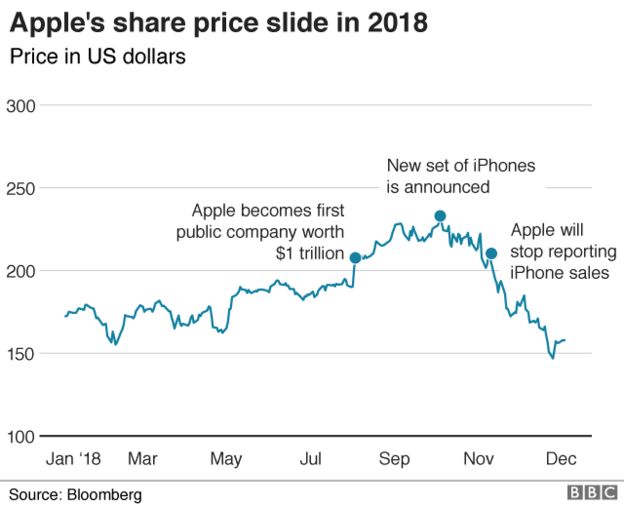
In this world, you can do many things in the market. But one thing I will suggest you do not do is to assume that your customers and consumers are stupid. Yes, we get into that phase where we think we can do anything and get away with it. People, it does not work that way. The last time Apple reported earnings, it was the most capitalized private company on earth. Today, it has lost hundreds of billions of dollars on market value.
What was Apple’s problem? It misfired on its pricing. And when that happened, customers revolted, leaving the one oasis in the company (the iPhone) and sales dropped 15%. Apple made an increasingly commoditized product category a fashionista product, putting the cost of iPhone out of the reach of many people.
The drop on iPhone sales was not going to hurt just on monetary terms, the planned transition into services (which grew 19% to a record $10.9bn for quarter ended 31 December) depends on more people using the devices since services win on volume. That explains why Apple wants to lower prices so that it can get many devices out of the stores. In most markets, Apple had already re-priced iPhone to make the device affordable for customers.
Apple boss Tim Cook has hinted it could lower iPhone prices in some places in an attempt to boost falling sales. Revenue from the iPhone, responsible for most of the firm’s profits, fell 15% in its latest financial quarter. Overall the firm’s revenue was down 5% from a year ago to about $84.3bn (£64.5bn).
[…]
But chief executive Tim Cook said customers were also struggling with the firm’s high prices.
He said a strong dollar, which makes its products comparatively more expensive, had hurt its sales in emerging markets.
Mr Cook said the tech giant had started this month to re-price its phones to shield customers from the impact of currency fluctuations.
Apple made a mistake here – its price modeling was off. Typically, companies do all to make pricing fixed in ways that they do not lose customers. I expect the numbers to adjust (i.e. sales to move north) now that Apple had started re-pricing its phones. Apple remains the leader on making the best smartphones in the world, and despite the competition, it has a clear moat on its strategy of proprietary hardware powered with exclusive software. Provided the pricing makes sense, many will still congregate into that Apple world for a long time.
It is a fashionista product. And fashions come and go. When you add stubborn pricing model, you drop 15% on sales. Apple tastes like orange right now!
Apple’s (AAPL) first quarter 2019 earnings results, by the numbers: Apple said Tuesday that its sales for the all-important holiday quarter hit $84.3 billion. The figure was slightly better than Apple had warned investors to expect earlier this month, but nonetheless represented a 5% decline from the same quarter a year ago.
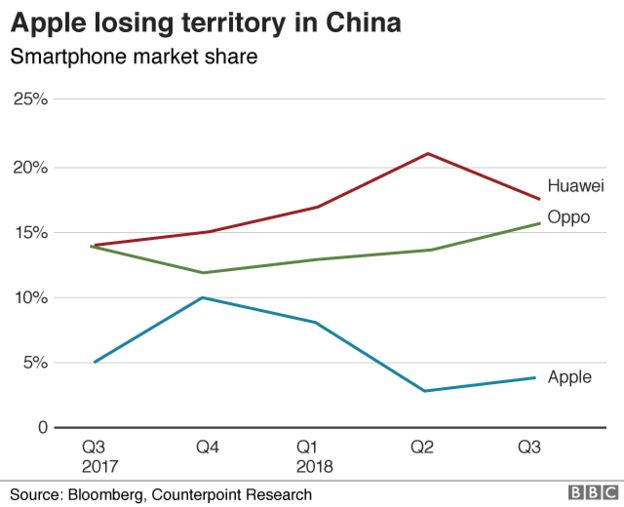
The sales decline was driven by a dip in iPhone sales, which Apple CEO Tim Cook previously said was primarily due to a slowdown in China. Apple’s iPhone revenue for the quarter fell 15%, to $51.98 billion.
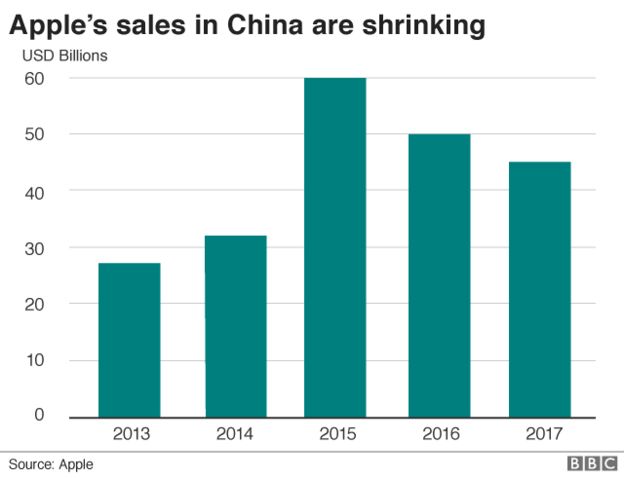
Apple’s sales in China also fell considerably. It reported revenue in the region of $13.17 billion, down from $17.95 billion in the same period a year ago.
Apple stock initially rose as much as 3% in after hours trading Tuesday following the report.
As iPhone sales drop, Apple has no other path than deepening services. It needs to open iOS to other hardware systems to grow the services business since you need volume to win on services.
The last funding report is out, from companies that typically compile them in Africa. The summary is this: Nigeria did well across number of deals and total dollar amount, overtaking South Africa in the process. It is evident that investors are plotting to win Africa through Nigeria. I see that as a strategic redesign as decades ago, the window into sub-Saharan Africa was opened to the rays of Johannesburg and Cape Town. It seems like lagoons of Lagos are looking better!
The report shows Nigeria emerged as the premier investment destination on the continent in 2018; with 58 startups raising a total of US$94,912,000. South Africa fell behind with 40 businesses raising US$59,971,000; while Kenya ranked third in terms of the number of startups that raised.
The report also contains in-depth data on the investment landscape in Egypt, Ghana, and Uganda; as well as an overview of activity in 14 other countries.
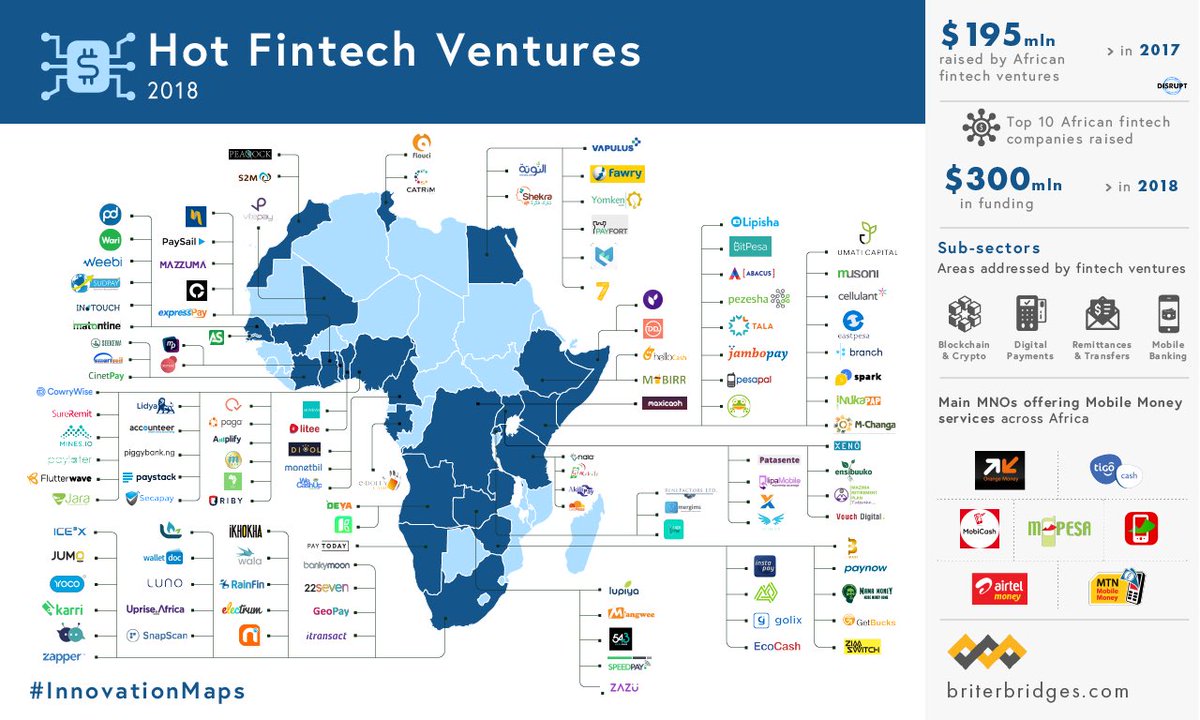
Sector-specific research shows the fintech sector remained the most popular among investors, attracting 39.7 per cent of total funds raised on the continent. Other spaces, such as e-health, transport and logistics are garnering ever-more attention and funding.
Yet, Disrupt Africa numbers are smaller than what WeeTracker had reported even though the trajectory is in the same direction.
According to numbers compiled in WeeTracker’s Venture Investments Report 2018, US$726 million was invested across 458 deals in African startups. That is a 300% gigantic leap in the total funding amount and over 127% increase in the number of deals as compared to 2017.
Fintech has remained the most funded sector in the continent.
Few years ago, I wrote in Harvard Business Review, on a piece on business model innovation, that one of the pillars of Microsoft success was not really technology but innovation on the legal mechanics of licensing software. Yes, while Windows was a generation-shaping technology, its success was anchored on the premise that you could pay for software and never completely own it, and must keep paying licenses to be legally allowed to use it, as a corporation.
If Toyota had done same, we may never completely own our cars even on full payment. That means you must return to a Toyota dealer yearly to service your car and pay a fee, if not, you could be seen as someone who is illegally using Toyota intellectual property. That Microsoft got away with it on software does not mean Ford could not have done the same, and got away with it, if that business model has been trialed at the onset of the automobile industry.
So, you will continue to pay for Windows or Oracle and unless your firm renews the yearly license, you will be under the wrong side of the law. There is nothing you can do about it because it is now the industry practice. And that brings me to something challenging in the telecom industry: why do fully paid data expire?
I mean why should I buy MTN, Glo, Airtel and 9Mobile, and after a certain period of time, the stuff will expire? Interestingly, the option for data expiration makes data affordable. Provided not many people will exhaust the sold-data, telcos price to discount it, instead of forcing everyone to pay the full price in a case data does not expire. There is a huge debate in South Africa on that right now.
To stop operators from offering data bundles which expire will limit consumer choice and result in higher data prices.
To call for the end of expiring data bundles will therefore not help consumers, but rather limit their choice and result in higher-priced data.
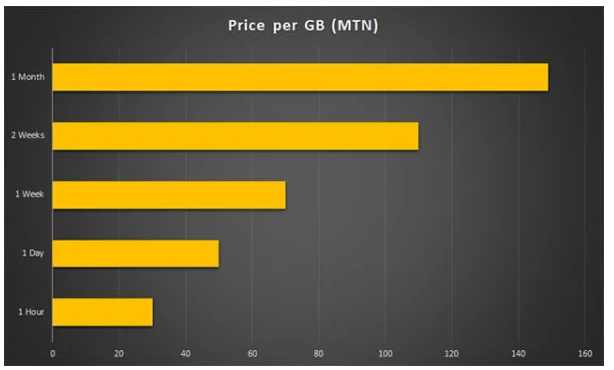
The chart below illustrates how the lifetime of data influences the price. It is clear that the longer data lasts, the higher the price is.
If you make it to expire in one month, it becomes more expensive (compared to one hour) because it could possibly be used. So, if you legislate that data will not expire, telcos will price at infinite “time” which means expensive data.
MTN South Africa explains:
MTN provides a wide variety of data bundles to the market to suit customers’ needs and usage requirements.
A variety of prepaid bundles are available to customers, ranging from a validity of one hour to one month. These bundles can be used on prepaid and can be added on to post-paid packages.
This enables customers to select a product, which meets their volume and validity needs.
The prepaid bundles are cheaper when the validity period is the shortest. For example, a customer can purchase a small data bundle for as little as R1.50 for a short validity period.
These small purchases are typically made to update a status on social media or check and send messages without having to make a large financial commitment.
Smaller purchases allow customers more control over their spend and increases data affordability by lowering the cost barrier.
At the same time, it allows the network to be used consistently over a period so that the investment in infrastructure does not lie idle.
This is an efficient utilisation of network capacity that may otherwise not have been used.
Expiry rules are also important for data network capacity and coverage planning purposes.
MTN must take into consideration the data service requirements of customers over a specific period of time and for specified data volumes. This information is vital for planning purposes.
Planning occurs well in advance, at least 18 months ahead, due to the long lead times for network deployment.
Capacity is planned to cater for this requirement and in addition thereto to allow for a margin of headroom on the network for unexpected traffic growth volumes.
If traffic exceeds these volumes, the quality of service experienced by customers on the network will be impacted negatively.
If, however, capacity is over provided for and not utilised this in turn will impact the ability of the network operator to manage the cost of providing data to customers.
If MTN were not able to determine the data requirements of customers and the period over which it will be used (indicated by expiry periods), the quality or cost of data will be affected.
It is important to note that MTN would need to pay its upstream providers for said capacity, regardless of whether customers utilise the capacity or not.
A longer expiry period would result in a substantial increased liability on balance sheet.
MTN is not able to recognise revenue for data bundle purchases until the data is utilised.
The increased financial unearned revenue liability on the balance sheet would have a negative impact on the MTN’s overall cost of capital.
As a result, the price of data would need to increase because the cheaper bundles with shorter validity would effectively become redundant.
MTN would need to rebalance data tariffs to cater for longer or no expiry rules.
This would mean that the current discounted in-bundle rates would not be available, and customers will pay a higher tariff for data.
My words to South Africa: it is not everything that must be regulated, leave telcos alone on this one. Expiring data makes data affordable as telcos play many optimization models to bring mobile connectivity inclusion based on the premise that not many people will end up using all paid data. Take that flexibility away, price will go high: the longer the time, the more expensive the data because you will likely use the data.
Sometimes regulations do regulate businesses out of existence, and then government turns around giving bailouts or seeding capital for businesses to grow again; a balance is always necessary. When we think we are fighting for the consumers, we end up hurting everyone, including the very consumers we should be protecting.
Telcos already have enough challenges going forward, not minding the substantial capital investment still expected of them, they also need a breathing space; they are being hit from all sides, including those from digital natives.
It’s always a challenge when you stuff regulatory agencies with people who never managed any business in the very sector they are meant to regulate; they barely understand the pain points the operators have. Too much bias towards consumers is always a problem, businesses also need to survive.
If businesses must continue to make investments and serve their customers well, there must be viable and clear path to profitability, else everyone will go home with poor services or no services at all.
I went in person to give Zenvus Enterprise Award for 2018. Chief Uche Sylva, CEO of Rewardn, made us better; with his partnership, we found new markets and territories. The quest to cure cure extreme poverty continues.
Rewardn is a leading soil water trap which works on different types of crops. It increases the water holding capacity of soils and generally enhances plant growth. With Rewardn, water and nutrients are available in the root zone for optimal absorption by plants. In agriculture, use cases include tree planting, nurseries, transplanting, landscaping, large scale farming, etc.
Also, Rewardn provides a buffer effect against climatic hazards with applications in erosion control, land reclamation, land embankment, among others.