DD
MM
YYYY

PAGES

DD
MM
YYYY

spot_img

PAGES

Home Blog Page 7028

Join Fasmicro’s Founders Mentoring

0

In Fasmicro Advisory Services, we have been offering services to founders, startups and companies via different mechanisms. Through workshops, presentations, and development of roadmaps & strategies, we have supported local and global entities with focus on Africa. Besides these services, we have assisted founders and leaders on their missions.

I am happy that after standardizing our Founders Mentoring, it is now available publicly. Over the years, we have developed and refined a framework to give support to emerging founders & leaders as they build their firms. The Founders Mentoring which requires annual subscription makes it possible for founders to have access via email, WhatsApp, phone, and skype to us with no restriction as they build. All services are described below.

  • Discovery Innovation Workshop: To innovate is to set a new basis of competition in an economy, business sector or market. Typically, it results to disruption. This workshop will focus on innovation and growth because growth is the reward of innovation. Otherwise, that innovation is actually an invention. I will be the lead instructor with my supporting crew. The table below provides the workshop structure. We can adapt this workshop to two days.
  • Founders Mentoring: We offer a service where we mentor emerging founders or business leaders as they build their companies. The founders /leaders would have direct access to our leaders, and we would guide them on business processes and systems. Through this service, they would email, speak, WhatsApp and Skype without restriction on issues affecting their companies. Simply, we become part of the ecosystem of the company. Imagine the ability to reach Prof Ndubuisi Ekekwe at anytime to discuss business frictions you have. The service operates on annual subscription.
  • We would help you see far
  • Innovation Presentation: This is a four-hour seminar where we will present what is happening in your market, customized for your company, and then offer insights on how you can plot your strategies to win. This goes beyond industry statistics and typical SWOT analysis. We work to help clients see their markets in new ways, providing roadmaps on how they can unlock opportunities. It is an intense talk, combining technology, finance, political economy and strategy. As technology redesigns markets, I break the implications in short, medium and long-terms.
  • Development of Business Roadmap & Strategy: A business plan is not enough to anchor business execution. A Roadmap Document is required especially in a sector which is in a state of flux [changing market, changing model, startup, competition, regulation, etc]. To avoid pursuing many windy paths or dead ends, a roadmap helps to encapsulate a profitable path to the vision with pillars and enablers necessary for success.

Connect with my team if interested in any of these services.

Sources: here, and here

Nigeria’s All-Time Greatest Banking Product

0

Steve Jobs executed it through iPhone, and business legends across industrial sectors have tested the construct. Perception Demand brings demand to markets beyond the needs and expectations but perceptions of customers.  A moment of seeing and liking products you never imagined could have been possible. But upon seeing the product, you become a fan – a higher call in customership.

The Perception Demand Construct is a construct where you work on things which are not really evident to be in demand. Yet you go ahead to create that product. The demand may not be existing but you are confident you can stimulate it. Yes, you do believe that your product can elicit demand and grow the sector when launched. This is different from existing demand which could be met via starting a web hosting company or selling light bulbs where you know people actually need those services.

As I explained in a 2010 piece in Harvard Business Review, it is the pinnacle of product innovation when scaled. It offers a new basis of competition and typically engineers disruptions in markets.

In Nigeria, one bank gave us a Perception Demand product. Diamond Bank’s DIBS (Diamond Integrated Banking System) was a peerless product when it was invented in 1990s. It ushered modern banking in Nigeria by making it possible that you could deposit money in one bank branch and operate the account in any of the same bank branches. That innovation, in my opinion, is the greatest product in the history of Nigerian banking. Yes, DIBS is the All-Time Greatest Banking Product in Nigeria. It was built on perception demand construct.

Comment on LinkedIn Feed

To succeed in perception demand construct, you must show character. Steve Jobs succeeded because he never imagined or envisioned a world where every person would have an iPhone on his or her hand, but rather he built for a niche, a league of people, then encouraged and persuaded those who weren’t in that league as at the time to aspire and join the ‘exclusive’ club. And today iPhone is celebrated, despite all the talks about pricing and not being ‘accommodating’; the usual recipes for quality degradation and loss of direction.

Again, that of Diamond bank’s DIBS perhaps succeeded because it never waited for internet connectivity to be across board, or thought of what would happen to those in the rural areas, and when others saw it, they keyed in; rather than waiting for a consensus or what would be suitable for everyone.

Whether in product development or anything in life, be bold enough to set a high standard, then stimulate or spur people to meet that standard. To build an enduring and sustainable product, you must decouple your mind from ‘products activism’, where you attempt to build for all comers, except if you are selling food.

Do not go low to accommodate others, rather remain up there and bring them to your level.


The Indomie Noodles Strategy

1

I confess that I have used Indomie noodles in all strategy sessions my firm has run in Nigerian companies. My wife Ifeoma likes the stuff but I am not sure I have ever tasted more than a spoon. But Indomie does not need me to be a consumer to be a fan of the strategy. Simply, one of the finest companies you need to study in Nigeria is Dufil Prima Foods (the makers of Indomie).

If you do what they are doing, you would find glory. I have papers on this business; it is a very delightful company. They understand Nigeria and they are delivering at the highest level. You want reality check? They consumed Dangote Noodles, doing to Dangote Group what it has done to many companies in Nigeria.  Yes, Dangote Group was outcompeted and it sold to Dufil!.

Business legends of Naija – the Indomie Noodles Strategy.

In this videocast, I explain how the makers of Indomie noodles used the same strategy Dangote Group had deployed across industrial sectors to defeat Dangote Noodles. The  accumulation of capability which Dangote Group uses to crush competitors did not work because Dufil Prima Foods (makers of Indomie) did the same thing from electricity generation to production, for its noodles business. With their vertically integrated business, there was no left efficiency which Dangote could exploit to improve quality and reduce price. At the end, an established brand won and Dangote Noodles could not dislodge them. Dangote Group later sold its noodle business to Dufil Prima Foods. This shows a practical model anyone that wants to compete against Dangote Group can deploy. Beware: you need to be very solid!


The Google Fi Mobile Service Plan

0

Google has a new unit that you can call a telecom company. Google Fi, the new name for Project Fi, is a mobile virtual network operator (MVNO) – “a wireless communications services provider that does not own the wireless network infrastructure over which it provides services to its customers”. In U.S., it offers subscribers a great deal when you consider what leading telecom companies charge.

Google’s wireless communications service Project Fi expanded its capabilities Wednesday, now offering its network to the majority of Androids and iPhones—a huge expansion considering the service was previously only available on Google’s own Nexus and Pixel phones, plus a handful of Android devices.

To make its growth official, the mobile virtual network operator (MVNO) service is rebranding as Google Fi. Under the new name, the three-year-old company will continue to offer subscribers unlimited talk and text for $20 per month with an additional $10 per gigabit of data used.

This deal is now available to phones running on Android 7.0 or higher with LTE bands 2 and 4, Venture Beat reports. For Apple, the device must have iOS 11 or higher, and it’s only available in beta through the Google Fi iOS app.

Nigeria is many years before MVNO but when that moment finally comes, you may be surprised that companies like Google may be interested. It would not hurt the real players like MTN and Glo since their infrastructures would still power whatever Google has in mind; Google will surely compensate them.

Data connectivity

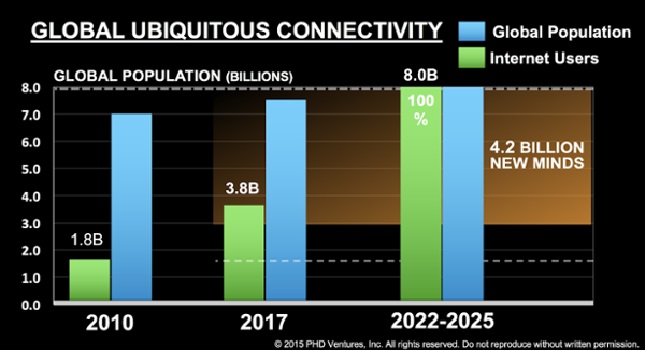
No matter how you look at it, immersive connectivity is on the way. I had predicted 2022 and it is looking real. This explains why you should be building internet-based businesses despite the present state of things. Yes, our digital sector will grow at exponential pace when that moment arrives.

The Implications

I predict that Google Fi mobile service plan would be the most promising service plan in Africa, helping telecom operators to move from prepaid services to contract-based services [that would make them more profitable removing the OTT challenges]. Because in near future, feature phones would fade and smartphones would take over, providing opportunity for Google Fi. Yes, it is possible that your mobile service can be infused into Android – the Google-owned mobile operating system – making it easier to sync phone software and billing for wireless services.

Simply, if your mobile operator is Google, your Android could as well collect the monthly plan payments. Besides, it is going to be possible to be phone-bill free if you activate a feature in Android which would enable Google to send adverts to you. There is no reason why you should not be building on the web – immersive connectivity is just around the corner.

Indigenous Knowledge in Africa and when Egyptians and Ethiopians were Category-King Innovators

0

When the piece on “top-grade education” ran, many expressed interests on understanding at deeper level some historical elements on indigenous knowledge and technology in Africa. Prof Gloria Emeagwali left a comment which seeded a debate on how a continent with a pragmatic scientific paradigm lost its ways.

Speaking about ancient Egypt, Homer, in the Odyssey iv. p.231 (circa 850BCE) points out that Egyptian doctors ‘are the first scientists of the world.’ Pythagoras, born around 558BCE, studied for 22 years in Egypt.The Hippocratic classification of head wounds was derived from the Edwin Smith papyrus – 2,500 years after it was first written by the ancient Africans – by Hippocrates (460 – 377BCE). Hippocrates was inspired by the books in the library of the Temple of Imhotep.

Isocrates (436-338BCE) testified on the Egyptian influence on Pythagoras. For Aristotle, Egypt was the cradle of maths. See his Metaphysics.

A great deal of Plato’s references were of Egyptian origin. See Plato’s, Timaeus. Plato also studied in Egypt in the era before the occupation of Egypt by the Macedonian, Alexander the Great. For three thousand years before that, Egypt built up its Indigenous Knowledge base.

Many asked questions on LinkedIn on the early virtuoso scientific advancements Africans had recorded. Prof has shared a document (Herodotus, PDF) that could help for deeper insights on this. I have extracted some parts below. Largely, Egyptians and Ethiopians were category-king inventors and innovators before they all went into paralyses where people that created scientific wonders are now struggling on how to purify water for drinking.

. So that if there were snow in that part of the world, there would necessarily be rain too; thirdly, the natives are black because of the hot climate.  Again, hawks and swallows remain throughout the year, and cranes migrate thither in winter to escape the cold weather of Scythia.

That, at least, is how I should explain the obvious impossibility of a dove using the language of men. As to the bird being black, they merely signify by this that the woman was an Egyptian. It is certainly true that the oracles at Thebes and Dodona are similar in character. Another form of divination – by the inspection of sacrificial victims – also came from Egypt.

The Egyptians did, how­ ever, say that they thought the original Colchians were men from Sesostris’ army. My own idea on the subject was based first on the fact that they have black skins and woolly hair (not that that amounts to much, as other nations have the same), and secondly, and more especially, on the fact that the Colchians, the Egyptians, and the Ethiopians are the only races which from ancient times have practised circumcision.”


Great Britain du