DD
MM
YYYY

PAGES

DD
MM
YYYY

spot_img

PAGES

Home Blog Page 7063

World’s Most Popular Sports Loved by Everyone

0

Sporting activities form a very important part of our daily lives. Professionals from MBA thesis services claim that people play games to keep fit, stay fresh and healthy. It is no doubt that sports are the most affordable and arguably the best stress-busters for many people. It is not a thing for the men alone. Women have also had the same interest in sports as their male counterparts. This has been made more and more interesting through technology that has made watching and listening to sporting activities possible. Today, there are many people watching and listening to live commentary from radio, TV and even on the internet. As a result, the sports concept is accessible to many people today.

Favourite Sports for Many

Definitely, there are differences in preferences of the type of sporting activities one would engage in. This is obvious owing to the fact that people have different likes and dislikes in almost every sphere of our lives. Even with that, there are some types of sports that are more popular than others and have found a huge following in and throughout the universe. Here are some of the most popular sports loved by everyone.

  • Golf

This is the most expensive sport in the world with a following of about 400 million fans. It is a ball sport and precision club where players normally known as golfers make use of different styles and strikes to hit a ball with an aim of landing it in a series of holes set up in the game field. The golfer hitting the maximum number of balls using minimum shots ends up as the winner. A lot of precision is required in this game. Although usually termed as a game of the rich, it is also played in many parts of the world including third-world countries.

  • Basketball

Despite being common in many other parts of the world, this sport has the biggest fan base in America. Around the world, it has a total of 400 million fans. The sport is normally played by two teams against each other with tackles and shooting balls using hands into a loop for a score to be made. The team with the many loop scores takes the day. It is tagged a game of the rich hence the reason you won’t find it in many parts of the world.

  • American Football

Though named after America, this type of football has also attracted a following in other nations like Fiji. It is definitely famous in America with a fan base of 410 million around the world. America likes doing things in its own way but because of its influence around the globe, many other people are also interested in what they do hence the huge following from many other areas.

  • Baseball

This game is mainly played in the USA but has also grown to attract fans and players I Cuba, Japan and the Dominican Republic among other nations. According to online editing jobs professionals, the fan base is around 500 million stemming from different parts of the world. It is a game played by two teams with players taking turns in this bat and ball game.

  • Table Tennis

As the name suggests, this is tennis on a table. It has attracted a fan base of about 900million from different parts of the world.  It can either played in singles or in twos meaning one player or two players to either side of the divide. Players are required to pass a light ball using small rackets over a net placed in between. 

  • Volleyball

With a fan base of about 900million, volleyball comes up in the top 10 sports loved by everyone around the world. It is a very intense game whether it is played by men or by women. The game is normally played by two teams separated at the centre by a net above them. Players are required to hit the ball using their hands with the aim of hitting it against the ground of the opposing team. 

  • Tennis

There are over 1 billion people around the world who love watching and/or playing tennis. A game of tennis comprises either two or four participants playing against each other. The game is played on clay courts, concrete courts or in a grass court among several other options. It is either one against one other person or two against two other people. 

  • Hockey

The fan base for this sport is about 2 billion people around the world. Field hockey is played by two teams where players endeavour to tackle and tactically move the ball or else puck into the goal post of the opponents. The complexity of the game is what makes the game full of fun. As a result, there are different versions of the game played around the world.               

  • Cricket

It is amazing how Cricket has had a huge following of about 3 billion fans around the world despite being played in only some odd 15 nations. The game comprises two teams with 11 players to each of the sides who bat and field. The team making the most runs or dismisses the opponents faster emerges as the winner. 

  • Soccer

This is arguably the king of all sports with a fan base of 3.5 billion people. Football has attracted a huge following around the world and is definitely the number one sport loved by all. A game of soccer comprises two teams each with eleven players. Winning against each other is by scoring into the goal post of the opponent. By observing it, one may think it is easy but it is 90 minutes of applying energy and skill to get past your opponents.

Final Thoughts

Sports form a very integral part of our lives and based on one’s interests and access to a certain sport, people will either engage actively in it or watch others play. These sporting activities come with a lot of benefits both social and physical. Here are the top most loved sports around the world.

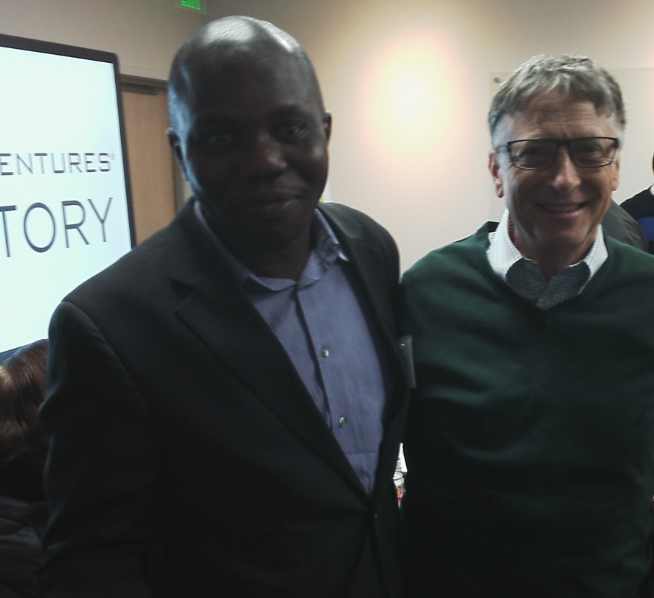
The Mirage of Lagos Dropouts – Mark Zuckerberg and Bill Gates

15

Continuing on the illusion that someone can dropout from a university, in Nigeria, and then become a legend, under the lame excuses that it worked for Mark Zuckerberg and Bill Gates. I want to make it clear that both Mark and Bill continued their “educations” but outside the university system.

In this discussion, the most important thing to note is that Life is about accumulating capabilities.  Accumulating those capabilities does not necessarily have to be in universities. The Igbo traders of Arochukwu, Nnewi and Ohafia have shown that people can create massive wealth even without going to school. Yet, in that process, one thing is clear: there is the generation and accumulation of knowledge which the apprentice-students acquire over more than a decade from their masters. That they did that in a shop in Aba or Lagos does not diminish the fact that they were “educated” or trained.

In America, they have an institutionalized apprenticeship system. A small segment of that system is the Executive Coach. These are highly experienced and capable men and women who are paid to become like private professors and mentors to busy people.

When I became a TED Fellow, TED gave me a coach. The man spoke with me many times in a week and helped in shaping my ability to get things done. He kept me on track, challenging me to speak better, and pushing me to fix many issues he felt I needed to deal with in order to be a better person in my projects. He did not spare my presentation styles: he worked hard on many nexus of my skills. He might have been paid $250 – $300 per hour by the billionaire who funded it through TED for the Fellows.

It was a transformation – I became a better communicator and quickly found it easier to just talk. The next few months, TED assigned another person who focused on fixing things related to planning and thinking big. He wanted me to become a big thinker and focusing on the big picture at early phases of projects.

People, these people are retired professors, company executives and extremely capable people who typically take you, look at your weaknesses and find ways to fix them in weeks. They are super-mentors because if you follow their directions, you will get results.

Mark Zuckerberg had many private coaches in Facebook. He had left Harvard as a “dropout” but he had Harvard-type professors as “private professors”. The same applied to most of those young men you read about that left school and built empires. In short, even those with degrees, do hire these coaches.

If a kid drops out from the University of Lagos, will he get his own private professor? The Igbo apprenticeship program makes a case that you do not need university education to thrive. But in that system, there is deep knowledge passed from one person to another.  Yes, in all cases, knowledge must be passed, one way or the other.


The key thing is to examine the reason for dropping out: Bill and Mark left to go and scale big ideas, and they had with them business and executive coaches working with them at those early stages. It was not because they were finding school hard or they did not like Calculus. They went to acquire, scale, and build massive knowledge. They went to “schools” but those schools were enterprises, and worked with some of the best in the world. The VCs who funded them are just like mentors and professors.

In a way, they replaced mass-training professors in Harvard with private Harvard-quality professors. If you check very well, they got better deals because they could afford them. You cannot have a private Harvard professor and still claim you dropped out!

Now, you can see why a kid in Nigeria must stay in school and stop touting how Mark and Bill dropped out to build Facebook and Microsoft respectively.

Growth Hackers Spend Money Bidding on my Name in Google Adverts (Photos)

0

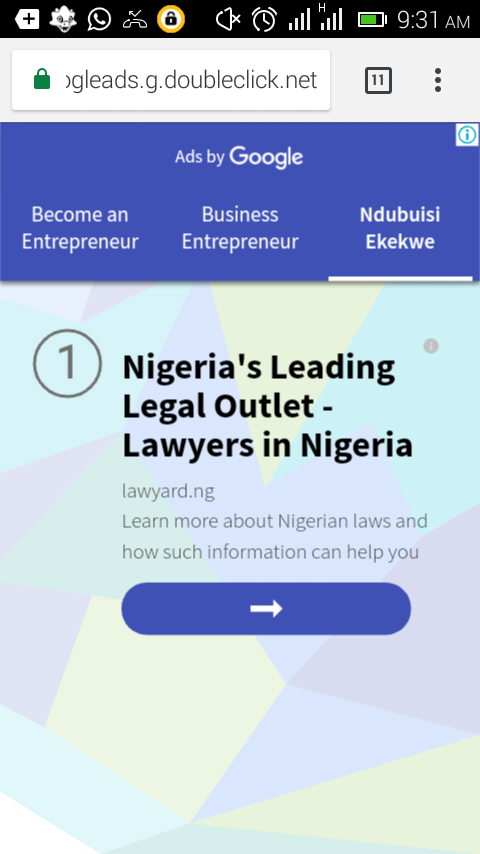
It looks very interesting when companies buy your name as a keyword in Google search. People in our online community have been informing me that they are seeing my name in some online adverts. Largely, I said “Really – I know nothing about that. Perhaps, some like to waste money”. But today, I was lucky. Trying to follow up a comment on an old piece, I saw my name – “Ndubuisi Ekekwe”. The company does startup legal advisory services and it has linked my name with specific phrases like “Become an entrepreneur” and “Business Entrepreneur”. This is interesting! I think my mother will like to know that people now pay for others to see my name. Possibly, she can understand that “Nd boy” is now “Nd Man”. Mothers – they never ever think you have grown!

Good luck to this firm. Linking my name with “entrepreneur” is awesome. I hope the clients are calling for them.

Screen captures…

For African Students, Mark Zuckerberg and Bill Gates Are Not Dropouts!

2

I wrote a piece on why people should focus on fixing processes which lead to underperformance instead of going into self-pity on the outcomes.

If you made 2.2 after working hard, you would be fine in your career. But if you made 3rd class because you did not have discipline or work hard, nothing will change in your life until you fix that process issue. Your problem is not the grade but the Process that resulted to the grade.

One commenter noted on LinkedIn: “Mark Zuckerberg and Bill Gates dropped out so why bother……tell them to learn the principles of money management and take a chill pill”.

For that comment, I respond as follows:

The secondary school Mark Zuckerberg attended is better than what most universities in the world offer to their students. His limited time in Harvard University is more than what most bachelor degree programs offer in Nigerian universities in quality in 4-5 years. The same goes for Bill Gates. My point is this: if you combine the quality of the secondary school and limited university education of Bill Gates or Mark Zuckerberg, anyone that argues they dropped out of university in Africa needs a needs a recalibration. Sure – they dropped out but they indeed “graduated” if you benchmark with our standards.

I wish Nigerian kids can “dropout”, well informed and prepared like Mark and Bill.

During Interviews, Position Your Inherent Capabilities Over Experiences

0

If you are looking for work especially in the technology sector, calibrate the emphasis on your working experience. While experience is valuable, the 21st century knowledge-driven business is one where hiring managers cannot just focus on assembling experiences. The key is inherent capabilities, and that means ability to learn and relearn. For some companies, they do not need doses of experiences – they need people who can understand big picture of things, and quickly learn to fix market fictions – the very essence of firms.

OFFERING employees a rewarding career used to be easy: You’d hire a bright young person out of college, plug him into an entry-level role, and then watch him climb the corporate ladder over the years as he progressed toward retirement. The company could plan for this continuous process—hire people based on their degrees, help them develop slowly and steadily, and expect some to become leaders, some to become specialists, and some to plateau.

Today this model is being shattered. As research suggests, and as I’ve seen in my own career, the days of a steady, stable career are over. Organizations have become flatter1 and less ladder-like, making upward progression less common (often replaced by team or project leadership). Young, newly hired employees often have skills not found in experienced hires, leaving many older people to work for young leaders. And the rapid pace of technology makes many jobs, crafts, and skills go out of date in only a few years.

So, when you attend interviews in those Lagos startups which are raising tons of millions of dollars, do not play the cards of the many years of working experiences unless you are interviewing for a top management job. Possibly, what they are doing may not even need your experiences, directly. They are looking for people who can quickly understand emerging patterns and adapt to provide solutions in the markets.

Key components of work of the future (source: Deloitte)

That is why in the interview, the hiring manager is not focusing on the past, asking you to explain how you ran a bank branch. Rather, she is focusing on how you can make it easier for a woman to pay the son’s school fees in Ghana from Lagos at the cheapest and fastest means legally possible. They are examining your thinking process to see what you can contribute over merely reviewing what you have done in the past.

But remember that your prior experience matters. Without it, they might not have invited you for an interview. But when you are before them, they want to talk about the future. Allow that flow to progress over drawing them back to the past. For most of these firms, it is not likely they need exact capabilities you deployed in your old industrial-age themed company.

So if you are not careful, too much experience can become a hindrance as you have known many things which cannot readily “work”. They may not even need people biased with those experiences which could possibly cage the mentality of breaking things and innovating at scale.

Experience matters but your capabilities for the future should be the main selling point for you as you interview before the hiring manager. For inviting you for an interview, they already know you are largely qualified. But you need to give them something extra as they make that call on the best person to join the MISSION. Discussing the past instead of what you can bring for the future will not help in that Call.