Good People, we have launched Tekedia Mini-MBA 3rd edition (Aug 10-Dec 3). This is coming because industry stakeholders asked for it as companies re-strategize post-lockdown. This 3rd edition is simply the same as the 2nd edition: four months, online, and costs $140 or N50,000 naira and taught by world-class faculty of Tekedia Institute. The optional $30 (N10,000) Lab Review remains.
More so, we processed feedback from Edition 1 and members asked for final projects. Accordingly, we have unveiled Certificate courses which are completely capstone-based. Tekedia capstone is a research paper or a case study exploring a topic, market, sector or a company. You must have attended, begun or about attending Tekedia Mini-MBA to qualify to register. You pick a topic and the Institute guides you: you produce a report under our guidance.
Here are the Certificate courses: each costs $60 or N20,000.
– Certificate in Logistics and Supply Chain Management
– Certificate in Startup and Small Business Management
– Certificate in Exponential Technologies and Singularity
– Certificate in Personal Career Development
– Certificate in Personal Finance & Wealth Management
– Certificate in Business Innovation, Growth & Sustainability
To Register for the 3rd edition of Tekedia Mini-MBA and/or the Certificate courses, click here.
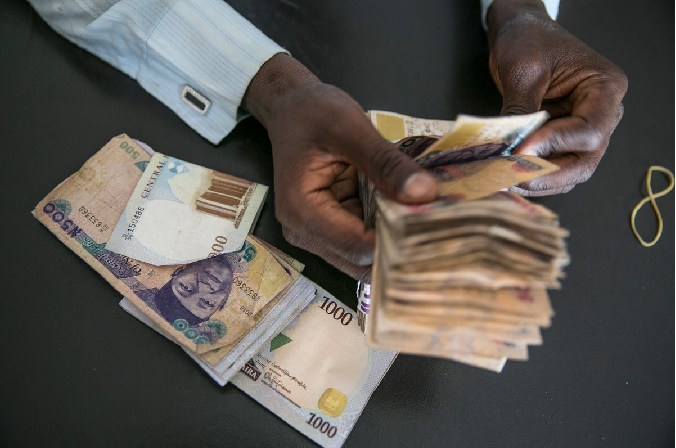
The Central Bank of Nigeria (CBN) has devalued naira in one of its currency auctions. Bloomberg reported that the development took place at an auction on Friday, where the central bank asked that bids for foreign exchange be made at N380/$1 against the $360/$1 that it used to be. Sources with the knowledge of the matter said the CBN is keeping the matter confidential for now.
Nigeria’s central bank devalued the naira at one of its currency auctions, according to people familiar with the matter.
The weakening comes after Governor Godwin Emefiele announced last month that the bank plans to unify its multiple exchange rates to improve the transparency of its currency-management system.
At an auction for importers on Friday, the central bank asked that bids for foreign exchange be made at 380 naira per dollar, compared with 360 previously, the people said, asking not to be identified because they’re not authorized to speak to the media. Isaac Okorafor, a spokesman for the central bank, didn’t answer calls to his mobile phone or reply to messages seeking comment.
It has been an interesting journey by the apex bank to stabilize naira since the outbreak of coronavirus that resulted in plummeted oil prices.
In March, the CBN devalued the naira, pegging the official rate at N360 from N307, though the apex bank’s governor, Godwin Emefiele said it’s only a technical devaluation. Multiple exchange rates have characterized the Nigerian money market and the central bank has been trying one policy after the other to keep the market stable.
In 2017, the apex bank introduced the nafex, a separate rate for investors and exporters that offers a stable exchange window for naira. The nafex window was designed to woo investors who have been scared away by the fluctuating exchange rates, and it has been stable around N388 since May when the oil price started showing signs of recovery.
The CBN introduced nafex as it was trying to avoid devaluing naira formally. But it has contributed to the multiple exchange rates obtainable in the country’s forex market. The parallel market has been repeatedly accused of hoarding the dollar in order to create artificial scarcity.
The International Monetary Fund (IMF) has warned Nigeria about multiple exchange rates, which it said creates confusion and spooks investors.
However, many believe that the CBN has been responsible for the instability of naira through its sharp practices.
Sahara Reportersreported on Thursday that the central bank has been hoarding the dollars remitted by Nigerians in Diaspora for dubious reasons, and cannot say the correct amount of foreign currencies that have been sent to Nigeria and exchanged with naira.
The report said that contrasting figures that have been put out, which drew the attention of concerned Nigerians, after the Secretary to the Government of the Federation, Boss Mustapha revealed in 2019 that remittances received by Nigeria stood at $19,6bn, $22bn and $25bn in 2016, 2017 and 2018.
Those who questioned the figures said more monies were remitted than what was revealed by the SGF, and accused the CBN of concealing the real figures.
“It is pertinent to let the public know that apart from hiding the fact that revenue from remittances are far more than oil revenue, all foreign aids and Foreign Direct Investment, the CBN wants to continue to sabotage the national economy through dubious regulations and that was why it banned banks and other foreign exchange dealers from paying foreign currencies to recipients of foreign remittances.
“Thus, by warehousing the dollar component of remittances in foreign banks, the CBN has made it impossible for the naira to appreciate against the dollar in the foreign exchange market.
“In view of the decision of the Federal Government to mobilize the huge diaspora remittances to serve as a catalyst for economic development in line with the provisions of the Nigerians in diaspora Commission Act, the CBN should be restrained from hoarding information on the money sent to the country by Nigerians living abroad,” a financial expert with knowledge of the matter told Sahara Reporters.
But the central bank said it had restricted financial institutions from issuing foreign currencies in order to help naira appreciate. However, the decision has failed to yield the expected result as naira has been on free-fall ever since the apex bank took the step, and has been repeatedly devalued.
Several forex policies of the CBN have been pointed at by critics as reasons for naira’s underperformance in the international monetary market. The bottom line remains that the IMF and investors’ admonition to Nigeria to have a unified exchange rate is far from a reality, and it is hurting the country’s businesses and chances for Foreign Direct Investments.
All the theories collapsed and one young girl made it happen: Maths and engineering are for boys because girls do not like numbers! Nonsense. Over the last few years, girls are running the numbers while boys continue winning in their video games. But for all these theories, one has confused me: why should the government of Anambra state be opening palm wine, celebrating the success of a young girl who actually schooled in Ogun state, as the lead celebrant?
I mean, if Nigeria is what you should expect, Maduafokwa Egoagwuagwu Agnes, the best JAMBITE, should be the pride of Ogun state. Magically, a governor was congratulating his counterpart in Anambra state for producing the best JAMBITE. But Egoagwuagwu never schooled a single day in Anambra state.
The first time I heard about the best ten candidates in the 2020 Unified Tertiary Matriculation Examination (UTME), aka JAMB, I was able to learn their various states of origin and their courses of choice. When I noticed that the first two candidates are from my state, I searched to see the schools that produced these wonders. I was hoping to see that they were students of one of the good schools in Anambra State, but alas, I found out much later that Maduafokwa Egoagwuagwu Agnes, the overall best candidate, schooled in Ogun State. The question I asked myself then was, “Why then should Anambra State take the glory while Ogun State did the job?”
This is not a case of being biased, but rather that of pointing out errors in our system. You can imagine suffering to raise a child from infancy only for her mother to come around when that child is an adult to claim her and then take all the glory that comes with the child’s achievements. Yes, I know a mother is irreplaceable, but the woman that raised that child should also be acknowledged at every point of the child’s life and success. Hence, there’s a need to acknowledge the players in these candidates’ success.
Nigeria needs reforms if we hope to make progress. It is painful to see how Nigeria operates: it does not look like a nation with all these smart people we meet everywhere. I spoke with a young man in our Tekedia Mini-MBA last week. His name was evidently Igbo, but as I tried to speak Igbo, he explained that he was born in Ife (Osun state), and he NEVER visited eastern Nigeria. He did explain that he could “understand” Igbo, but could not “speak” it. Yet, his political and national service would be tethered to eastern Nigeria even though this is a real Ife boy.
Buhari and Osinbajo should fix this national tribal paralysis by using law to discontinue state of origin for state of residence. Once a Nigerian lives in a state, for at least 6 months, all rights should accrue to him or her for that state.
It is getting ridiculous how we are still running Nigeria in 2020. Can some be annoyed for once in Aso Rock and save this nation? As we congratulate Agnes, and feast on her success politically and otherwise, Nigeria should understand that we can have more like her if we have better structures in this nation. The Ogun state governor should own this moment, and not his Anambra state counterpart. Yes, Ogun state raised Agnes, not Anambra state; all accolades should go to Ogun.
Comment: Even if state of Origin is erased in papers, I don’t think it can be erased from our minds. What if as an Abia girl I am by origin and have schooled and lived in different States, how will the Government handle such scenarios Sir?
My Response: Your new state of residence where you lived MOST of the last 6 months should be what matters. You can run and vote in that state, not the state of your father (as always the case) or where you were born. By doing that, we begin to detribalize. Our tribalism is rooted in the law we have now. But if we change the rule book, our actions will evolve. Born in Lagos as Adamu Musa, you are a Lagosian. But moved to Abia and lived there for 2 years, you become an Abian and can contest governorship there. Your mindset becomes what can make my living place better!
Invent, innovate and drive organizational transformation, performance, and growth. Capture emerging opportunities in changing markets while optimizing innovation and profitability. Digitally evolve your business or functional area, turning digital disruption into a competitive capability and advantage. Master the concepts of building category-king companies, and thrive.
Registration for Tekedia Mini-MBA edition 3 begins. This program is a 4-month weekly innovation management program, beginning Aug 10 to Dec 3, 2020. It will comprise videos, flash cases, written materials and webinars delivered online, and optimized for business execution and growth, with digital operational overlay. When we finish, we will issue a certificate from the Tekedia Institute USA.
Register and join us. You will emerge transformed with tools and capabilities that engineer confidence, performance and growth. Accelerate your leadership ascent with us and have access to speak with me on your career and professional development! Tekedia is also unveiling certificate courses.
CODE
PROGRAM
MINI
Tekedia Mini-MBA costs US$140 (N50,000 naira) per person.
MINR
Add extra (optional) $30 or N10,000 if you want us to review and provide feedback on your labs.
Add extra (optional) $60 or N20,000 for each certificate specialty course. You must have attended, begun or about attending Tekedia Mini-MBA to qualify. The following Certificate tracks are available:
CLSM
Certificate in Logistics and Supply Chain Management
CSBM
Certificate in Startup and Small Business Management
CETS
Certificate in Exponential Technologies and Singularity
CPCD
Certificate in Personal Career Development
CPFM
Certificate in Personal Finance & Wealth Management
CBIS
Certificate in Business Innovation, Growth & Sustainability
The Certificate program is completely capstone-based. Tekedia capstone is a research paper or a case study exploring a topic, market, sector or a company. Tekedia Institute supervises the work.
How To Register:
PayPal: follow this link and pay $140 US dollars (or more if adding the optional components). It supports most global currencies.
Bank transfer (Nigerian naira): Pay N50,000 (or more if adding the optional components) into any of:
GTBank 0114016493
UBA 1019195493
Account owner: First Atlantic Semiconductors & Microelectronics.
Theme: Innovation, Growth & Digital Execution – Techniques for Building Category-King Companies
Introduction
Over the last few decades, digital technology has emerged as a very critical element in organizational competitiveness. It has transformed industrial sectors and anchored new business architectures, redesigning markets and facilitating efficiency in the allocation and utilization of factors of production. The impacts have been consequential: nations like Nigeria are moving towards knowledge-based economic structures and information societies, comprising networks of individuals, firms and states that are linked electronically and in interdependent relationships. In this program, we will examine this redesign within the context of fixing market frictions and deploying growth business frameworks in a world of perception demand where meeting needs and expectations of customers are not enough.
Program Time: Aug 10 – Dec 3, 2020
Venue & Format: Online via videos, articles, webinars, and flash cases. Program is self-paced which means you consume the materials at your own time and pace.It is completely online. You will have something to complete within 7 days. You decide when you do that within the window. Where you live or your time zone would not be an issue as program is not live-delivered.
Cost: US$140 (N50,000 naira) (20% discount for bulk registration of at least four). We have payment plan, i.e. installment payment plan.
Program Structure: The program structure is presented below.
Theme: Innovation, Growth & Digital Execution – Techniques for Building Category-King Companies
Week
Date
Focus
1
Aug 10
Innovation & Growth
The Innovation and Growth of Firms – Prof Ndubuisi Ekekwe
Digital Transformation, Innovation & Strategy – Jude Ayoka, Manager, Access Bank Plc
Innovation Lessons: 5in5 (5 Firms in 5 Sectors) – Africa/Global – Aderinola Oloruntoye, Dean, Workforce Group
2
Aug 17
Business Systems & Processes
Business Playbook, Manual and Execution – Prof Ndubuisi Ekekwe
Process Improvement and Operations Management – Rasheed T. Adebayo, Operations Manager, Schlumberger
Quality and Asset Management – Michael Odigie, Vice President Technical Services, Delek Logistics
3
Aug 24
Business Model & Transformation
Modern Business Models and Growth – Prof Ndubuisi Ekekwe
– AI & Cloud – Wale Olokodana, Azure Business, Microsoft
– Data Management, Big Data Analytics – Dr Adewole C. Ogunyadeka, esure Group Plc
6
Sept 14
Finance, Investing, Fundraising
Investing and Fundraising – Victor Ndukauba, Deputy Managing Director, Afrinvest West Africa
Capital Market Operations – Azeez Lawal, CFO, TrustBanc Group
Personal Finance and Wealth Management – Japheth Jev, CIMA(UK), CGMA, ACA, Japheth Consulting
7
Sept 21
Logistics & Supply Chain Management
Supply Chain Systems and Management – Ayodele Adenaike, COO, GIG Logistics
Outlook on Supply Chain Management – Luiz Paulo Silva Barreto, Graduate of MIT Supply Chain Management
Logistics – Samuel Akinniyi Ajiboyede, CEO, Zido Logistics
Lab #1 – Tekedia Institute
8
Sept 28
Marketing, Sales Management & Business Objectives
Sales Management, Marketing and Growth – Moby Onuoha, Queen’s University
Stimulating New Markets Through Innovation And Perception Demand – Prof Ndubuisi Ekekwe
Execution – Business Objectives and Technologies, Nnamdi Onyebuchi, CEO, Weco Systems Group
9
Oct 5
Live Session Q/A (will be recorded)
LIVE SESSION: Building Your Business Financial Models (templates included) – Michael Olafusi, Financial Analyst Fellow, Brightmore Capital; Lead Consultant, UrBizEdge
Career and Jobs During Pandemic – Captain Ola Olubawale, CEO, Seamate Australia
Career Planning – Precious Ajoonu, Manager, Jobberman
10
Oct 12
Leadership and Human Capital
Business Process and Leadership – Prof. Ayodeji Oyebola, Saint Mary’s University of Minnesota
Human Resources Management .- Adora Ikwuemesi, Director Kendor Consulting
Leading and Managing Teams, Stakeholder Management with NICER Model – Dr. Chisom Ezeocha, Project Delivery Manager, Shell
11
Oct 19
Media & Branding
Media, Communications, and PR – Grace Akinosun, CEO, smepeaks
Branding and Advertising – Akachi Ngwu, Executive Director/COO, Luzo Digital Network & Media
– Fintech – Olugbenga GB Agboola, CEO / Co-Founder, Flutterwave
– EdTech – ‘Dimeji Falana, CEO, Edves
– Agtech – Ndubuisi Ekekwe, Founder, Zenvus
– HealthTech – Enoh John, CEO, Lafiya TeleHealth
Lab #2 – Tekedia Institute
13
Nov 2
Career Week (see below)
14
Nov 9
Global Markets & Projects
Supply Chain Management, Global Partnership & Contracting – Adebayo Adeleke, ex-Chief of Contracting and Deputy Chief, Business Operations Division, US Army
Business & Commercial Law – Chukwuemeka Mbah (LLB, BL, LLM) Law, Manager, Sherwin Williams
Contracting, Negotiation and IP – Jeff Chineme Maduka (LLB, BL, LLM), Snr Legal Manager, American Tower
17
Nov 30
Sustainability & Risk Management
Disruptive Sustainability Innovation for Long Term Business Growth – Eustace Onuegbu, President, incsr.org
Sustainability Strategy and Social Innovation – Temitayo Ade-Peters, CEO, We For Good
Risk Management – Akeem Rasaq, Head Of Risk Management, Chapel Hill Denham
Lab #3 – Tekedia Institute
18
Dec 3
Execution & Growth
Driving Profitable Growth, Marginal Cost, Scaling – Prof. Ndubuisi Ekekwe
The Call to Execution (Summary) – Prof Ndubuisi Ekekwe
Report , Closure
*(Weekdays and Saturdays have Live sessions; the contents are recorded for replay). **In some names (law, accounting, etc), we have to put the professional titles due to the regulatory nature of the fields.
Certificate Programs: We processed feedback from Tekedia Mini-MBA Edition 1 and members noted they would like to do projects. Accordingly, we have unveiled new Certificate courses which are completely capstone-based. Tekedia capstone is a research paper or a case study exploring a topic, market, sector or a company. You must have attended, begun or about attending Tekedia Mini-MBA to qualify to register. Each certificate course costs $60 or N20,000.
CLSM Certificate in Logistics and Supply Chain Management
CSBM Certificate in Startup and Small Business Management
CETS Certificate in Exponential Technologies and Singularity
CPCD Certificate in Personal Career Development
CPFM Certificate in Personal Finance & Wealth Management
CBIS Certificate in Business Innovation, Growth & Sustainability
Tekedia capstone is a research paper or a case study exploring a topic, market, sector or a company. You will pick a topic which the Institute will approve.Then you will go and execute that project. Think of this as a final year student product in a university. We expect it to last a maximum of 3 months. The member will submit a report at the end of the capstone. For someone who wants to start a business, you may choose a topic to do market study in that sector. You design a questionnaire and execute your study. Essentially, the essence of this is to apply what you have learnt in the Mini-MBA to produce a practical business document. Here, we provide potential capstone topics (the topics are limitless):
A digital logistics strategy for Lagos State
Market study for website design business in Northern Nigeria
The competitiveness positioning of Jumia in African ecommerce
The future of fintech in Ghana
Implication of AI technologies in African banking
My personal career roadmap: 3, 5 and 10 years
Building wealth via Treasury Bills
Business longevity roadmap for ABC Limited
Angel investing market in Kenya
A comprehensive business plan with market data for ABC Limited
This edition 3 is the same as edition 2; some stakeholders have asked us to run another edition now that the pandemic is stabilizing in most regions
Career Week: To Transform Workers into Leaders and Innovators.
Our Career Week (Nov 2-6 2020) is not designed for finding jobs. Rather, it is structured to TRANSFORM workers, founders & entrepreneurs into business leaders and champions of innovation in their companies. The sub-theme is Nurturing Innovators: Career Planning & Resilience During Disruption. It will be packaged under the Tekedia Mini-MBA theme of Innovation, Execution & Growth. Our knowledge experts for the Week include human resources experts and leaders from MNCs and startups, across industries and global regions:
Dupe Akinsiun – Head, Leadership & Capabilities Center, Coca Cola HBC
Abraham Owoseni.com – Principal Consultant, MindMould
Video presents overview of weekly session
Target Audience: This program is designed for professionals across functional areas like sales, marketing, technology, administration, legal, strategy, finance, etc across all business sectors and domains.
Learning Objectives: To innovate is to set a new basis of competition in an economy, business sector or market. Most times, it results to disruption. This program is designed for private (large, SMEs, startups) and public institutions. Participants will:
Master the mechanics of digital growth – the reward of innovation – through frameworks, cases and evolving strategies.
Understand how to undergo digitization journey that is fully aligned with corporate objectives through measurable and realizable benchmarks.
Acquire business capability tools that do not just RUN their firms but can TRANSFORM them.
Design corporate growth experiments in Lab sessions based on One Oasis Strategy, Aggregation Construct, Double Play Strategy, Accumulation of Capability Construct, and more.
Facilitator:Prof Ndubuisi Ekekwe invented and patented a robotic system which the United States Government acquired assignee rights in 2017. Dr Ekekwe holds two doctoral and four master’s degrees including a PhD in engineering from the Johns Hopkins University, USA. He earned undergraduate degree from FUT Owerri where he graduated as his class best student. While in Analog Devices Corp, he co-designed an accelerometer for the iPhone. A recipient of IGI Global “Book of the Year” award, a TED Fellow, IBM Global Entrepreneur and World Economic Forum Young Global Leader, Prof. Ekekwe has held professorships in Carnegie Mellon University and Babcock University, and served in the United States National Science Foundation Committee. The South African press called him “a doctor of innovation” for helping organizations on the mechanics of business innovation, strategy and growth. Since 2009, the Chairman of Fasmicro Group which controls many startups and entities has been writing in the Harvard Business Review.
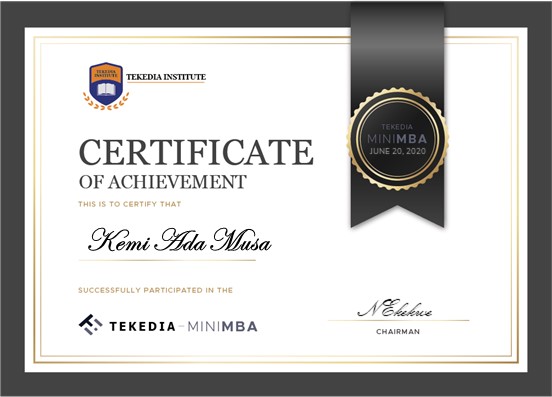
Our sample certificate which will be awarded to participants
Tekedia Mini-MBA Corporate
Tekedia Mini-MBA Corporate is a customized version of the general Tekedia Mini-MBA. It is designed for private and public institutions. It focuses on the same theme of innovation, growth and digital execution. But unlike the 4-month general Mini-MBA, the Corporate vision goes for 6, 8,10 or 12 weeks. Email for a quote.
A participant received a promotion after implementing a playbook in our session.
“Sir, I am overjoyed. I just received a promotion. On Thursday, I sent to my CEO a Covid-19 Continuity Plan, using the template you made available in Tekedia mini-MBA class. Early today, management asked me to present it via video. Ten minutes ago, I received an email from Head Admin that management wants me to execute that template, and they also promoted me. I am also getting a refund for my personal investment on this training. I want to say thank you to all the faculty for this service.”
A participant received funding after using ideas from our session on fundraising.
“I discarded my business plan and used the Week 1 business canvas on the Challenge Assignment. Today, I am happy to share that less is indeed better: we received $25,000 from an investor. I want to thank all the faculty especially Mr. Azeez Lawal. His course on Fundraising with African sense is the best ever. I also thank you for a statement in one of the class videos, “Your customer can be your investor. Believe this… the best investors are customers”. This investor is a customer and we will begin by serving his company even though we are a separate company.”
Selected faculty
Testimonial from Soulmate Industries Ltd
Free for all Mini-MBA edition 2 participantsFree for all Mini-MBA edition 2 participants
There have been statements that if anyone can survive in Nigeria, such a person can survive anywhere in the world. Perhaps, there are good reasons for saying this.
Nigeria has the largest population in the African continent, and one of the largest in the world. It is also an endowed nation as almost all the states have abundant natural resources. These resources include crude oil, coal, tin, uranium, lead, and so many others. The country has arable land as well which enables her to grow different crops such as yam, cassava, maize, millet, sorghum, tomato, cabbage, carrot, beans, oil palm, rice, etc, as the list is inexhaustive. This makes the country one of the best places to live in, and Africa’s top economy by GDP.
However, the same country has been bedeviled by conflicts, corruption, and abuse of power in recent years. These conflicts range from religious to ethnic conflicts. There are the Farmer – Herdsmen clashes which had left thousands dead, and many communities destroyed. This, the government has blamed on foreign nomads while the people affected claim they are Nigerians. Of course, we do not know who is saying the truth and who is not.
There have been so many accusations against the government in recent years for disregarding court judgments and being insensitive to the plight of the citizens. Of course, we understand that the government cannot be everywhere at the same time. As it is said, ‘uneasy lies the head that wears the crown.’ However, the arrest of some activists by government security agencies even without trial, in recent times, is a strong point the citizens have against the government. Citizens are afraid to speak up against government policies to avoid arrest, making it more difficult for one to be a Nigerian.
The issue of corruption has become an integral part of the system, from the Executive, to the Legislature and Judiciary. Successive governments have come up with policies to tackle corruption, but it has been a herculean task , as its taproot is as old as the country itself. Therefore, it would need the effort of both the government at all levels and citizens to tackle. The country has been labelled as one of the most corrupt countries by international ratings. It is more outrageous because while we blame our leaders in our country for being corrupt, foreigners blame the citizens. It used to be embezzlement of funds and money laundering by political leaders (elected and nominated).
Now, it is human trafficking, drug trafficking, and internet scams. How about the issue of bias in recruitment into federal jobs or schools? There has been a public outcry , of the government’s special treatment to a particular tribe or region over others in key selections/appointments. The sound of this allegation is getting louder and louder by the day, as there is a trend. Hence, the clamour for certain groups for a restructuring of the entire process in the country, from security to fund allocation, so as to enable every region develop at their own pace, with the resources they have. This is still debated, and would be a determining factor in the future case for the continual existence of Nigeria as a country.
Being Nigerian is not so easy, as we have to work hard to make decent wages in a country that has one of the lowest minimum wage structures in the world for her workers, and one of the highest pay structures for her legislators. Of course, it is laughable.
At foreign airports, being Nigerian is associated with crime such as fraud. Although we have great citizens who make us proud overseas, we still have to grapple with the negative information the International press has labelled the country with, due to the activities of fraudulent fellows. Therefore, outsiders look at us with an extra lens. While other nationals are given a free pass, we are searched multiple times. They have been put on a red alert, and so do not believe that good people still exist here.
Of course, growing in a country such as this , you will get to experience the effect of corruption on the system. From the security officials on our highways demanding bribes, to the lecturers in our higher institutions demanding for one form of compensation or another to give you your score. How about those who demand a huge amount of money to give you a school admission that you deserve? Or the public service workers who want to be generously rewarded before they approve your request or process your documents? While we blame our political leaders for accepting bribes for contracts awarded, the same scenario is playing out in our communities as people resell land that belong to others, so as to cart away with their money.
As a result, it has become increasingly difficult to be a Nigerian. It’s no wonder some Nigerians emigrate to other countries to be sane, because day by day, we are losing our sanity. Everyday, we try to remind foreigners that we are nice people, hospitable people, when amongst us, we slander one another , and even stigmatise based on tribe and religion.
In other words, being Nigerian has become a stigma as some of our African brothers drive us out of their countries. We cry for fairness, equality and justice in our country. It is not surprising why our leaders send their children to foreign schools…they do not believe in our educational system anymore. They understand what it means to be a Nigerian, and do not want their families or wards to experience the same, for it could be traumatising.