DD
MM
YYYY

PAGES

DD
MM
YYYY

spot_img

PAGES

Home Blog Page 7124

Nigerian Universities Approved by NUC for Postgraduate Studies

2
National-Universities-Commission-NUC

The National Universities Commission (NUC), Nigerian university system regulator, has released a list of approved postgraduate awarding schools, Premium Times reports.

“The commission hereby notifies the general public that only the following universities have approval to offer postgraduate programmes at the Masters’ and Ph.D levels in Nigeria as of July 30,2012,” the bulletin said .

According to the bulletin, Nigeria has 162 universities: 41 are federal, 47 are state owned while 74 are privately owned institutions.

Under the different classes, here are the schools.

 Federal Universities

1. Abubakar Tafawa Balewa University, Bauchi

2. Ahmadu Bello University, Zaria

3. Bayero University, Kano

4. Federal University of Technology, Akure

5. Federal University of Technology, Minna

6. Federal University of Technology, Owerri

7. Micheal Okpara University of Agriculture, Umudike

8. Modibbo Adama University of Technology, Yola

9. National Open University of Nigeria, Lagos

10. Nigeria Defence Academy, Kaduna

11. Nnamdi Azikwe University, Akwa

12. Obafemi Awolowo University, Ile Ife

13. University of Abuja, Gwagwalada

14. University of Agriculture, Abeokuta

15. University of Agriculture, Makurdi

16. University of Benin, Benin City

17. University of Calabar, Calabar

18. University of Ibadan, Ibadan

19. University of Ilorin, Ilorin

20. University of Jos, Jos

21. University of Lagos, Akoka

22. University of Maiduguri, Maiduguri

23. University of Nigeria, Nsukka

24. University of Port Harcourt, Port Harcourt

25. University of Uyo, Uyo

26. Usmanu Dan Fodio University, Sokoto

State Universities

1. Abia State University, Uturu

2. Adamawa State University, Mubi

3. Adekunle Ajasin University, Akungba Akoko

4. Ambrose Alli University, Ekpoma

5. Anambra University, Uli

6. Benue State University, Makurdi

7. Cross River University of Technology, Calabar

8. Delta State University, Abraka

9. Ebonyi State University, Abakaliki

10. Ekiti State University, Ado Ekiti

11. Enugu State University of Science and Technology, Enugu

12. Imo State University, Owerri

13. Kogi State University, Anyigba

14. Ladoke Akintola University of Technology, Ogbomoso

15. Lagos State University, Ojo

16. Nasarawa State University, Keffi

17. Niger Delta University, Wilberforce Island

18. Olabisi Onabanjo University, Ago Iwoye

19. Rivers State University of Science and Technology

20. Umar Musa Yar’Adua University, Katsina

21. Gombe State University, Gombe

22. Ibrahim Babangida University, Lapai

23. Kano State University of Science and Technology

24. Kebbi State University of Science and Technology

25. Kwara State University, Malete

Private Universities

1. African University of Science and Technology, Abuja

2. American University of Nigeria, Yola

3. Babcock University, Ilishan Remo

4. Benson Idahosa University, Benin City

5. Bowen University, Iwo

6. Covenant University, Ota

7. Igbinedion University, Okada

8. Pan-Atlantic University, Lekki

9. Redeemer’s University, Mowe, Ogun State

10. Caleb University, Lagos

11. Joseph Ayo Babalola University, Ikeji-Arakeji

12. Nigerian Turkish Nile University, Abuja

13. Afe Babalola University, Ado Ekiti, Ekiti State

14. Lead City University, Ibadan (MSc. Only)

15. University of Mkar, Mkar (MSc. Only)

16. Madona University, Okija

17. Al-hikmah University, Ilorin (MSc. Only)

18. Godfrey Okoye University, Ugwuomu-Nike , Enugu state.

Also, NUC noted that “Employers of labour, educational institutions and other stakeholders are to note that only certificates issued by these universities for their approved programmes, are valid for employment, further studies and other purposes,” according to the Premium Times report.

As you decide to apply in any of these schools, NUC has also provided the official ranking of Nigerian universities.

[Apply Grant] Win $250,000 from Google Nigeria – $20 Million Committed

0
Google-Headquarters
Google-Headquarters

Google has unveiled Google Impact Challenge (GIC) Nigeria 2018. This is a Google grant program designed to impact communities. It was launched yesterday in Lagos. The goal is to award grants to NGOs which are using technology to drive social impacts in Nigeria.

The search giant is committing $20 million over the next three years across Africa; Nigeria will get $6 million from that budget. The company will spread $2 million to Nigerian entities yearly.

For this year, there would be 12 winners; top four will get $250k each while eight runners up will get $125k each.

APPLY HERE. Deadline is July 4th.

Judges will determine the winners. Some of the judges include the Chief Executive Officer of Channels Media Group (John Momoh), CEO of Zinox Technologies (Leo Stan Ekeh), Kanu Nwankwo and Parminder Vir (Tony Elumelu Foundation).


African Agriculture’s $1 Trillion Crusade and How to Participate

2
AfDB president Akinwumi Adesina
Akinwumi Adesina

Last year, AGRA noted that African agriculture could hit $1 trillion by 2030 from then $313 billion. The report was based on a World Bank research [this report has $313 billion, not $300 that AGRA used]. By comparison, the 2017 GDP of Africa was around $2.2. trillion (nominal).

Most indications are that we are ready for take-off. The prospects for African agriculture looks favorable, despite the recent slowing in economic growth across much of the continent mainly due to the sharp drop in the global prices of oil and minerals. The African food market continues to grow with World Bank estimates showing that it will be worth US$1 trillion by 2030 up from the current US$300 billion. Demand for food is also projected to at least double by 2050. These trends, combined with the continent’s food import bill, estimated at a staggering US$30–50 billion, indicate that an opportunity exists for smallholder farmers—Africa’s largest entrepreneurs by numbers—who already produce 80% of the food we eat to finally transition their enterprises into thriving businesses..

The African Development Bank returned to the same number – $1 trillion- in this year’s meeting in Korea. Indeed, Africa is entering a golden era of agricultural production where technology will drive productivity. We expect continuous improvement in crop yield over the next few years. Everyone knows that fixing agriculture will fix Africa because more than 65% of Africa’s working population is employed in agriculture. So, it has the most catalytic impacts possible in raising millions of people out of poverty.

The African Development Bank (AfDB) yseterday call on African governments to create the right environment for the private sector to lead the continent’s industrial revolution.

“We cannot say we have leadership when we still have 65 per cent of the land in Africa uncultivated. We must develop solutions to agriculture and ensure that the sector can grow to a $1-trillion business,” its President, Akinwumi Adesina, said.

Unlocking Opportunities in African Agriculture

I do believe that we would reach $1 trillion before 2025 with the pace of incremental innovation in the sector. The disruptive innovation is not anywhere around because critical infrastructures like electricity and storage facilities that would enable such are not readily available yet. Nonetheless, African agriculture is getting the attention of many people in the continent at the moment.Here are ways entrepreneurs can play in the sector:

  • Precision agriculture by making sensors: here, you make electronic sensors; may be a little hard depending on your skill level
  • Agriculture insurance technology: making insurance products geared for farming
  • Agro lending technology: delivering capital to farmers at scale supported by technology
  • Agro financing – investing in farmers and farms through digital aggregators
  • Direct Farming: owning farms and growing crops and/or raising farm animals
  • Farming ecommerce: expanding farmers’ markets by providing digital platforms for trade
  • Pricing aggregation: facilitating trading through provision of produce price data
  • Storage: African farmers struggle with storage of produce. Building solutions in this area will be catalytic
  • Logistics: there is a huge opportunity to facilitate the delivery of produce from rural areas to urban areas across Africa with our poor road networks
  • Digitization of transactions: from payment to tracing origins of produce, we have a huge need to digitize farming systems in Africa
  • Commodity trading: building exchanges for trading commodities
  • Farm digitization: most farms must be digitized for them to be tech-ready
  • Others: there are opportunities like making digital tools farmers can use. These could include farm diary, mapping solutions, etc

Note: depending on your skill level and areas of capabilities, you may need partners in executing some of the ideas.

All Together

This race to $1 trillion is clear – if you fix agriculture, you would fix most problems in Africa. According to McKinsey, a consultancy, African agriculture was worth $100 billion about eight years ago. Now, it has hit about $400 billion meaning that we are on the right track but still have a lot of work to do. Agriculture and the capacity to feed Africa would drive the expected productivity we desire in the continent.

Simple Math, eliminate poverty to increase productivity. When you eliminate the fear of what to eat, the human mind works better. Nigeria needs two major inputs – money and ideas – if we want to create wealth.

Why Number of Nigerian Banks Will Shrink by 50% before 2030

0
Nigerian market currency

I have looked at the operations of some of the largest Nigerian banks and can arrive at one thing: the big banks are now platforms of huge ecosystems. If they continue the separations from the second- and third-tier banks, the latter group would fizzle or become extremely diminished within a decade. Platforms are efficient because they have both internalized and externalized capacities to grow through network effects at increasingly lower marginal cost. GTBank, especially,  is now a technology company with a banking license. With its position in the market,  few entities exist that can dislodge it from its vantage position.

The best modern technology businesses are platform-anchored, not product-driven. Facebook is a platform. Apple has a platform. Google runs as a platform. These are among the most valuable companies on earth. As marginal cost goes lower in the internet age, platforms will rise because of the positive continuum of network effects. From aggregation construct to one oasis strategy, businesses with consumer focused frameworks are wired to succeed if they are platform-oriented.

From Marginal Cost to Profit Margin (Net Income to Revenue)

Our banks recorded one of the best years in 2017. They made real money. And they did this even “while the sector’s non-performing loans soared from 5% in June 2015 to 15.6% last October, the IMF says”. Simply, they can make money as technology companies and not as banks. So, if you expect them to be making money from interest, you have not understood that the banks are now technology companies. And they belong to the platform category where money comes in small bits. In typical tech companies, you watch for marginal cost, in the banks you look for profit margin. Last year, the profit margin was great (the cost-to-income ratio, CIR, follows thus).

Sources: Bloomberg and IMF staff calculations

I expect the profit margins to continue to improve. There is no reason why that should not be the case. The positive continuum of network effect will surely work for the banks. But as that happens, only the strongest will survive [I do note that most of the 2017 profits came from foreign currency floats, treasury bills, etc. Yet the transaction-fee income continues to grow faster than interest income. The banks will continue to innovate on extracting these fees].

Winner-Takes-All

The transition into a technology category means we are going to have some of the banks losing grounds. Yes, what typically happens in technology would happen here. As I noted few weeks ago in the Harvard Business Review, when the winner takes all, many casualties abound.

And global consumer technology powerhouses like Tencent and Google use customers to generate data that drives growth and revenues. These companies aggregate the data and scale massively with near-zero marginal cost, which is all made possible by the internet. Because they are ahead with an enormous number of users, they keep getting better, and the data they accumulate drives improvements in their algorithms. Changing this order is largely hopeless, and that creates a competitive stasis for local entrepreneurs.

In our banking, some of the leading banks will be the winners. There would not be space for the weaker ones because banks are simply competing within a technology domain and not necessarily banking ecosystems. Just as you cannot have many great search companies, social media companies and so on, Nigeria would not have many banks (yes technology companies with bank licenses).

These banks are now wired to make money under most circumstances: the currency crisis was a golden year for most.

Banks with net dollar assets were beneficiaries; GTBank, Nigeria’s most profitable bank – and its biggest by market capitalization – made N80 billion in 2016 from the devaluation, says its chief executive Segun Agbaje, or roughly $260 million at the post-devaluation rate.

FBN Holdings, the second-largest bank by assets, also recorded a N80 billion revaluation gain that year.

{…]

Zenith Bank, Nigeria’s biggest by assets, reported that derivatives income increased almost 250% to N68.7 billion last year ­– that’s equivalent to $225 million at the 305 rate,

Regulation Will Not Change the Trajectory

As our banks transmute into technology companies, regulating them would be more challenging. As I have noted, using Facebook, explaining that if you decide to break “Facebook apart, one part will grow and dominate others. This is possible because of the positive continuum of network effect where the biggest keeps getting bigger and also better. … You can regulate Facebook but another company will come to take over its position because in this sector, it is winner-takes-all. Yes, the best wins.  Why? The scalable advantage improves with lower marginal cost”. Simply, there is an inherent nature that one company in a platform ecosystem will triumph at the end. Yes, few banks will win and many will go under in the retail banking sector.

And that is the problem. With their high scalable advantages running on aggregation construct, digital empires like Facebook and Google can take up offline empires, and may still not be within the crosshairs of the regulators. No one can effectively regulate Facebook, for example, unless you want another company (not named Facebook) to take its position. The operating structure of the business is mutative, and that means that it can grow through network effects which reward the best: a better service brings more users, and the more the users, the better the service, setting up a positive continuum. So, if you break Facebook, one part could grow and over time could dominate other parts, provided that part is the surviving best. Or another company with stronger advantage, post-Facebook breakup, would take over the new market and become the new category-king.

The Unification via BVN

With BVN (Bank Verification Number), many bank customers do not need to have many bank accounts. People have since consolidated especially in this age of huge fees where you pay for debit cards, and stamp duties for electronic transactions. Simply, customers will choose the banks they think are the best and stay with them. The rest would be closed, partly to avoid fees and mainly to simplify their lives. While banks would keep adding users [there are many outside the system], having more users is a lousy metric in Nigeria. What really matters in my opinion is the quality of the customers. As I noted few days ago, MTN Nigeria has seen ARPU dropped from $22 to $4.14 and truly struggles to make as much money despite having millions of more customers.

To help me understand the impact of WhatsApp and other OTT solutions, I pulled MTN Group financial report in 2006. In 2005 (yes 2005), MTN Nigeria was recording ARPU of $22. Today, it is $4.14.

So, you have to expand resources to support many customers and at the end you make nothing from many. The best customers are already with the leading banks. Leading banks like GTBank and Zenith Bank will become aggregators driving many smaller ones to edges. It is like Google Search giving Yahoo search a tough time. At the end, the best wins and most customers aggregate to it.

All Together

There is a massive consolidation happening in the Nigerian banking sector. I expect many of the smaller banks to exit the scene. Even if they remain, their impacts would be extremely marginal. Today, the market cap of GTBank is more than the whole sector if you remove the top two following GTBank. That disparity is showing in the profit margin of GTBank which is industry-leading (yes, that is the near-zero marginal cost typical in platform-based technology companies). With GTBank’s digital transactions growing 90% year on year, you would agree it is not a typical banking number. This summarizes it: add the impact of continuous digital penetration which will stimulate more platform benefits, the picture becomes clearer why 2030 may be too far for 50% of the players to exit (or if they remain, their impacts would be only marginal).

“There will be winners and there will be losers in the Nigerian banking sector as it becomes much more competitive,” says Ndiritu of Allan Gray. “I don’t think all banks are created equal in Nigeria.” There is still plenty of room for Nigeria’s banks to grow. The ratio of their assets to GDP was just 30% in 2015, compared with 55% in Kenya and 102% in Egypt, according to EFG Hermes, an investment bank. But with the easy money that has flowed from the state over the last couple of years drying up, it will be clearer than ever which ones are built to last.

Zenvus Boundary Now Supports Public Search of Limited Property Records

0
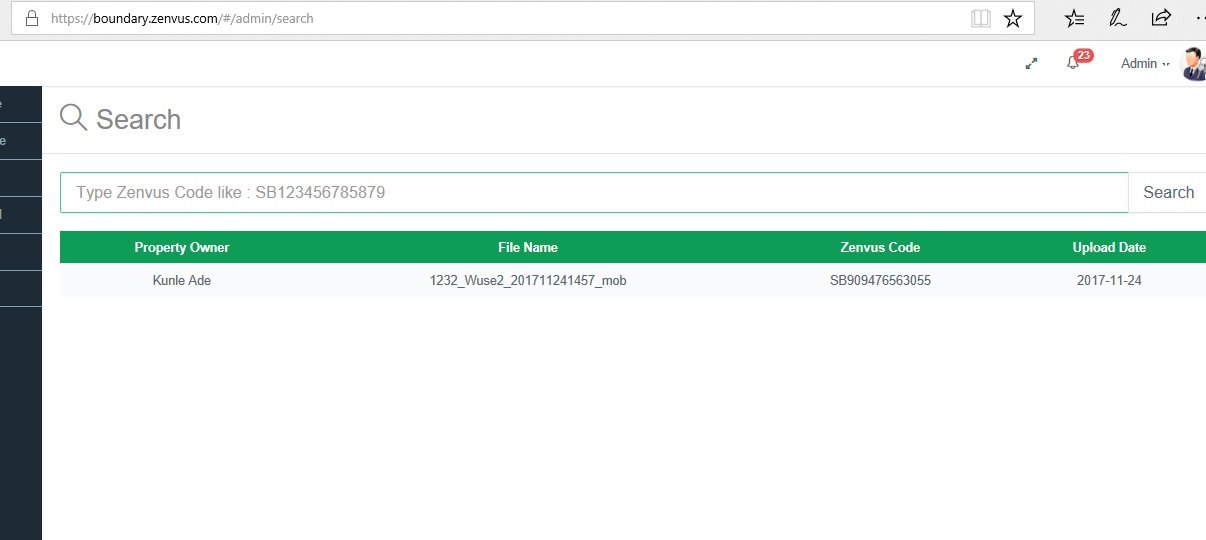
Sample of Zenvus Boundary Public Search

To Farmers & Franchise Partners:

We have added a new feature, public search, to Zenvus Boundary. Many of you have asked for a public way to authentic and validate your property reports [this does not substitute your government data if available]. Our farmers want ways to authenticate the survey reports before partners [for example, you want to simply show the existence of the farmland, location and size to an investor, etc].

This feature is now activated for all Zenvus Boundary Pro administrators (i.e. franchise partners). You should share the link with your farmers. Once you type the report SB code (the Zenvus code), the record will appear if we have the code in the system. To ensure privacy, search works with only Zenvus codes and not the names of the owners of the properties. Everything is done on real-time connecting to the Zenvus engine.

This is how the search outcome looks (see below). It does not provide the full survey report. It simply confirms the existence of the Zenvus code in the system and the name of the person the specific code is associated with.

By next week, the new feature will go fully public, and that means it would not require login for anyone with the SB code to search the records. We are testing to be sure the spam blocker is working well before public release.

Sample of Zenvus Boundary Public Search

Zenvus Boundary maps farm boundaries and populates them via GIS on Google Map where the survey maps can be printed in our portal. Farmers do this without any external help. And when done, register with their cooperatives which help them ratify the boundaries with governments. We use this to formalize farmlands and enable financial inclusion. Below is a sample result which the farmer can take to a bank as collateral for loans.

A farmer upon using Zenvus Boundary can download a PDF of the farm boundary report (sample below) in Zenvus account. The Zenvus Boundary Pro enables cooperatives or unions to have their logos and names emboldened in the reports for each member farm. We have some franchising opportunities here.


Sample of Zenvus Boundary Report